VIPAS Energy
HomePlatformCapabilitiesOperating modelUse casesAbout
Media & InsightsBook a discovery call
  1. Home
  2. Media & Insights
  3. Stop rebuilding the same energy context in…
Systems That Don’t Talk

Stop rebuilding the same energy context in five tools.

Finance, BI, procurement, sustainability and operations each export and clean their own copy of the same sites, meters and invoices, so one site ends up with five numbers. The rebuild is the symptom of missing operating context.

  • November 9, 2026
  • Carousel
  • 8 slides
  • 2 min read
View on LinkedIn (opens in a new tab)Share on LinkedIn (opens in a new tab)

Carousel slides: Stop rebuilding the same energy context in five tools.

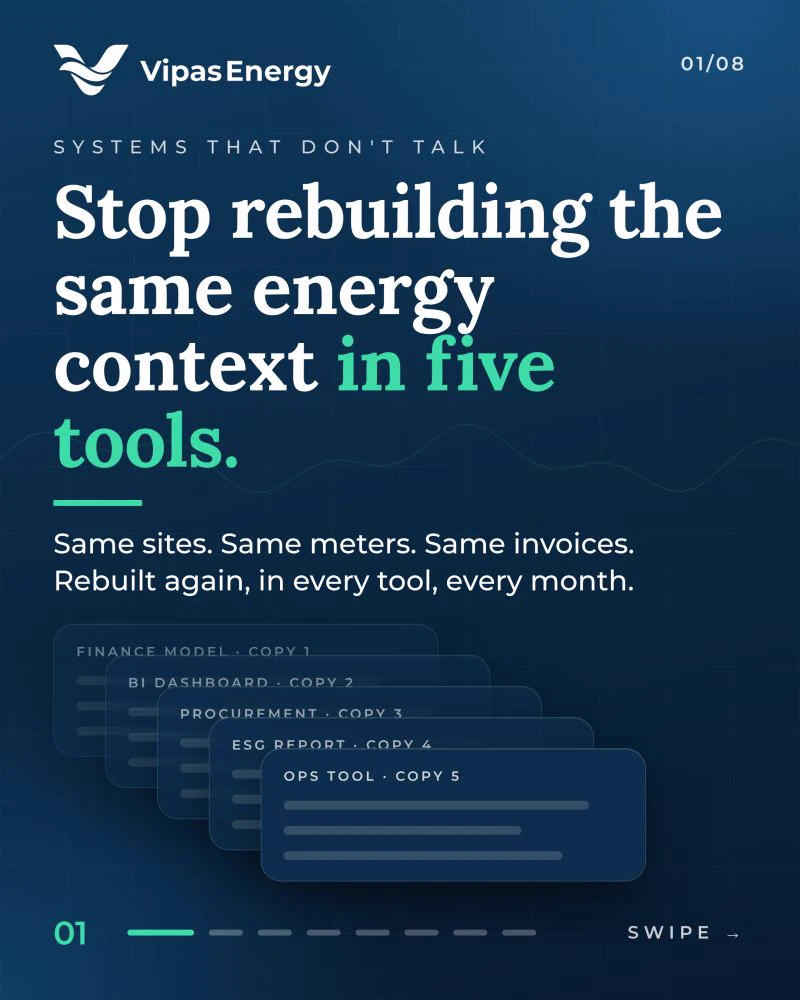
  1. Systems That Don't Talk: stop rebuilding the same energy context in five tools. Same sites, same meters, same invoices, rebuilt again in every tool every month: finance model, BI dashboard, procurement, ESG report and ops tool.
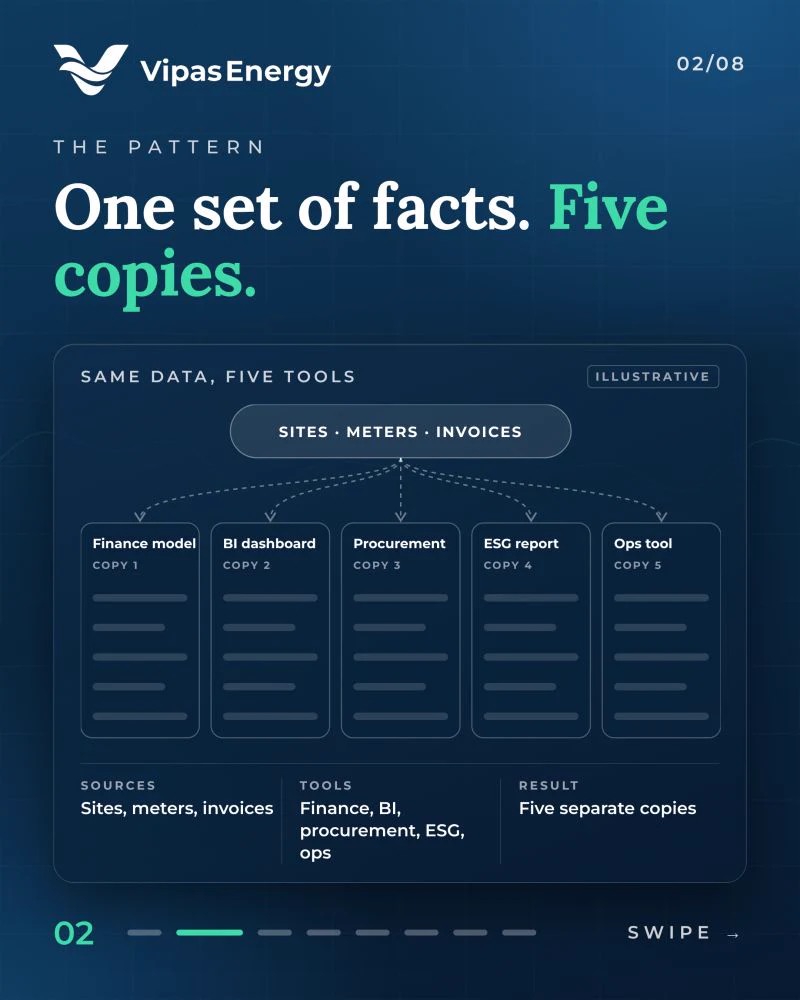
  2. The pattern: one set of facts, five copies. The same sites, meters and invoices feed a finance model, BI dashboard, procurement, ESG report and ops tool as five separate copies. Illustrative.
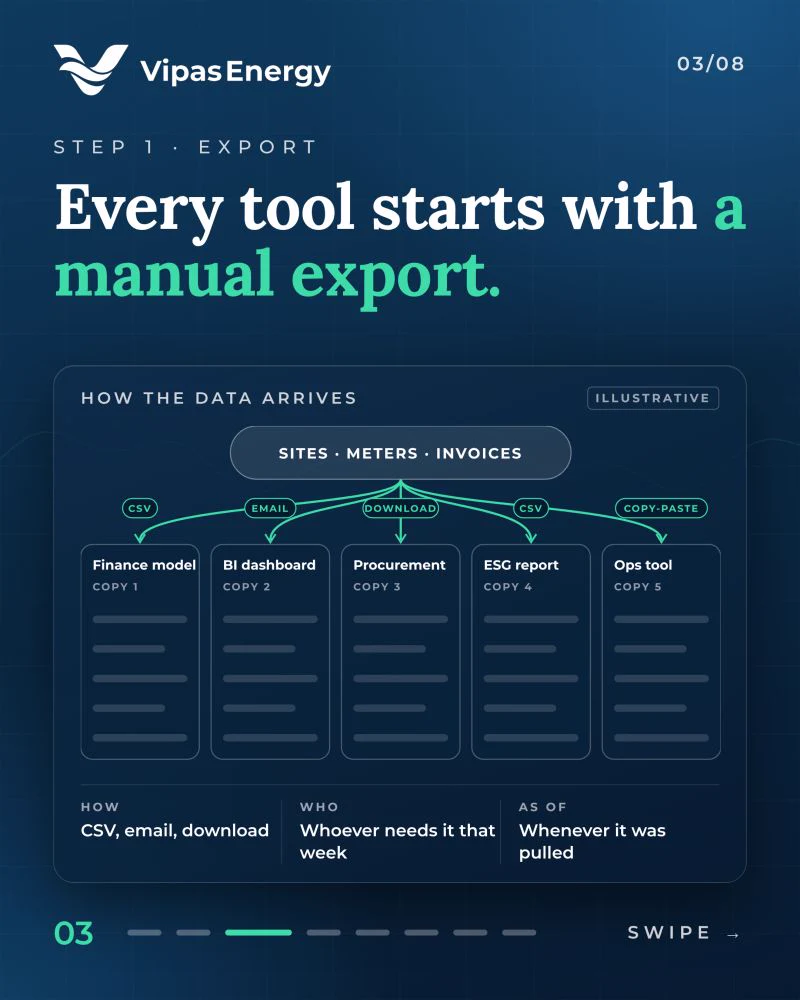
  3. Step 1, export: every tool starts with a manual export, by CSV, email, download or copy-paste, pulled by whoever needs it that week and as of whenever it was pulled. Illustrative.
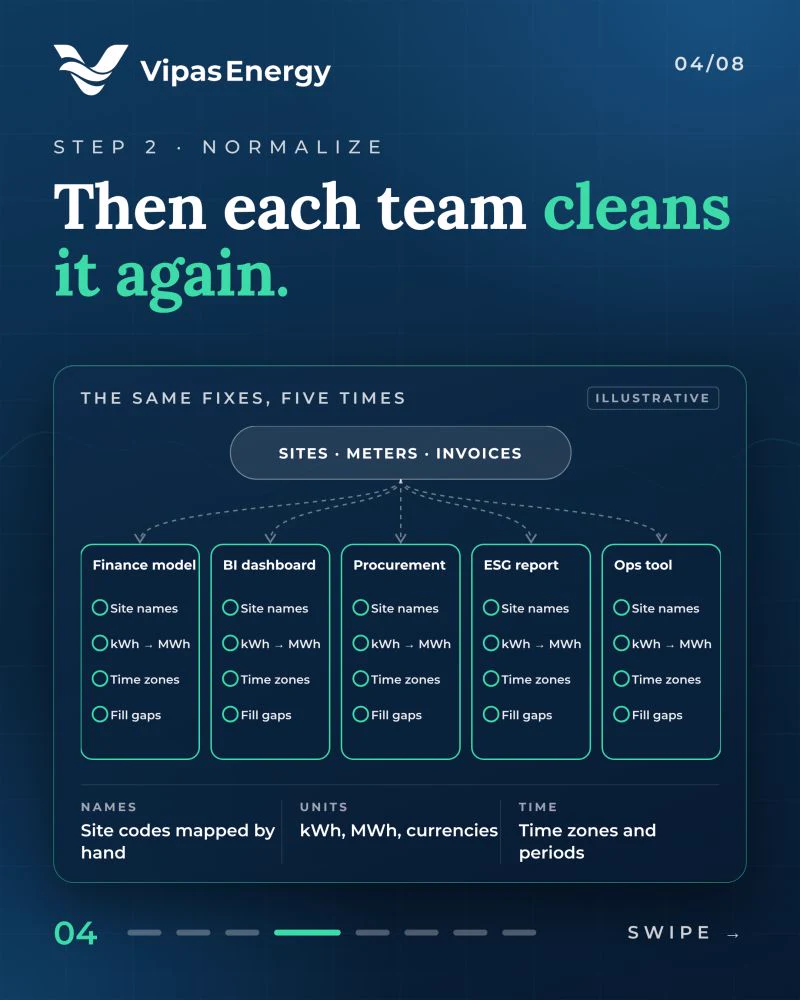
  4. Step 2, normalize: then each team cleans it again. Every copy repeats the same fixes: site names mapped by hand, kWh converted to MWh, time zones aligned and gaps filled. Illustrative.
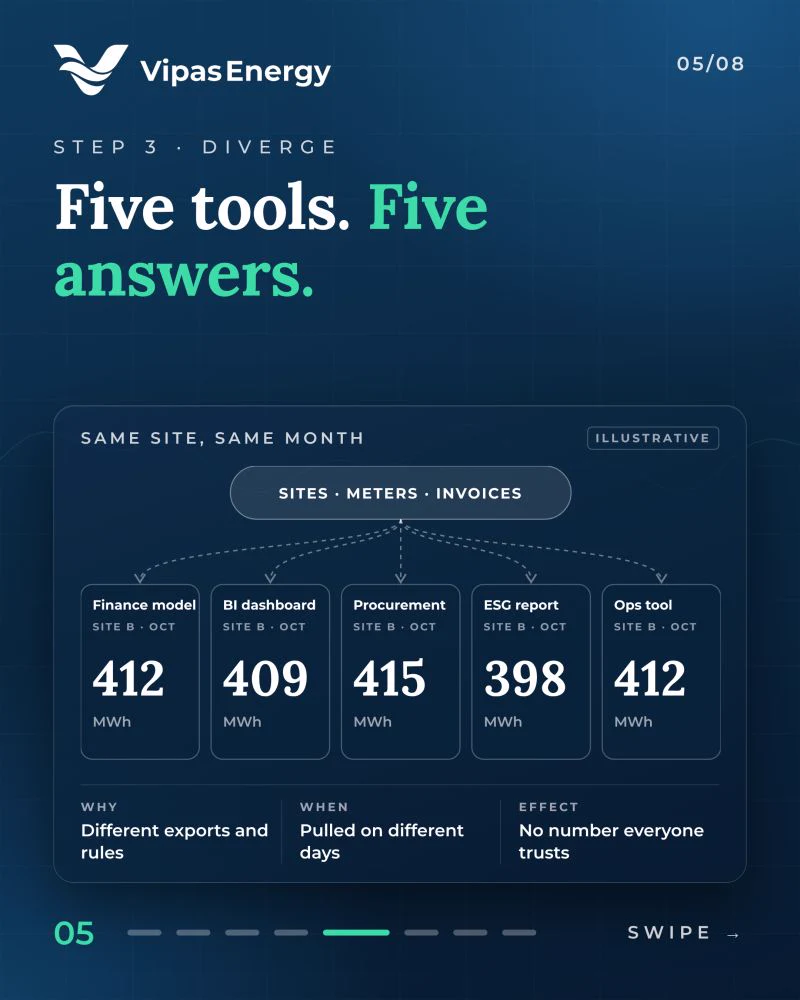
  5. Step 3, diverge: five tools, five answers. The same site in the same month reads 412, 409, 415, 398 and 412 MWh across the five tools, because of different exports, rules and pull dates. Illustrative.
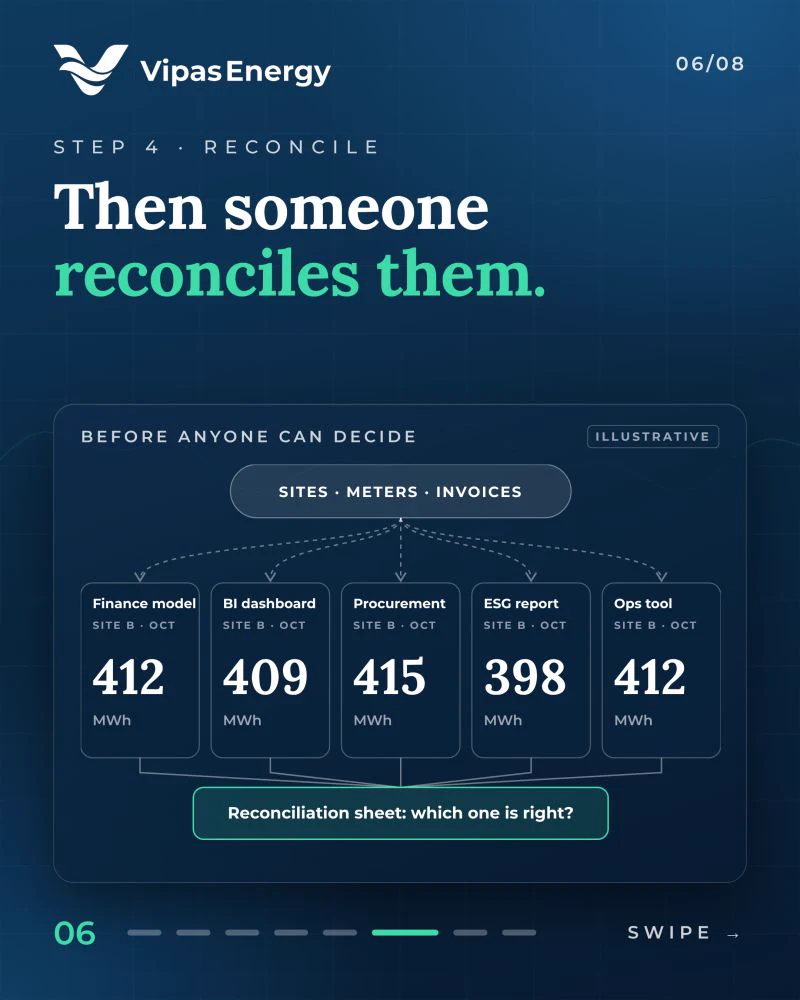
  6. Step 4, reconcile: then someone reconciles them. Before anyone can decide, the five different numbers go into a reconciliation sheet asking which one is right. Illustrative.
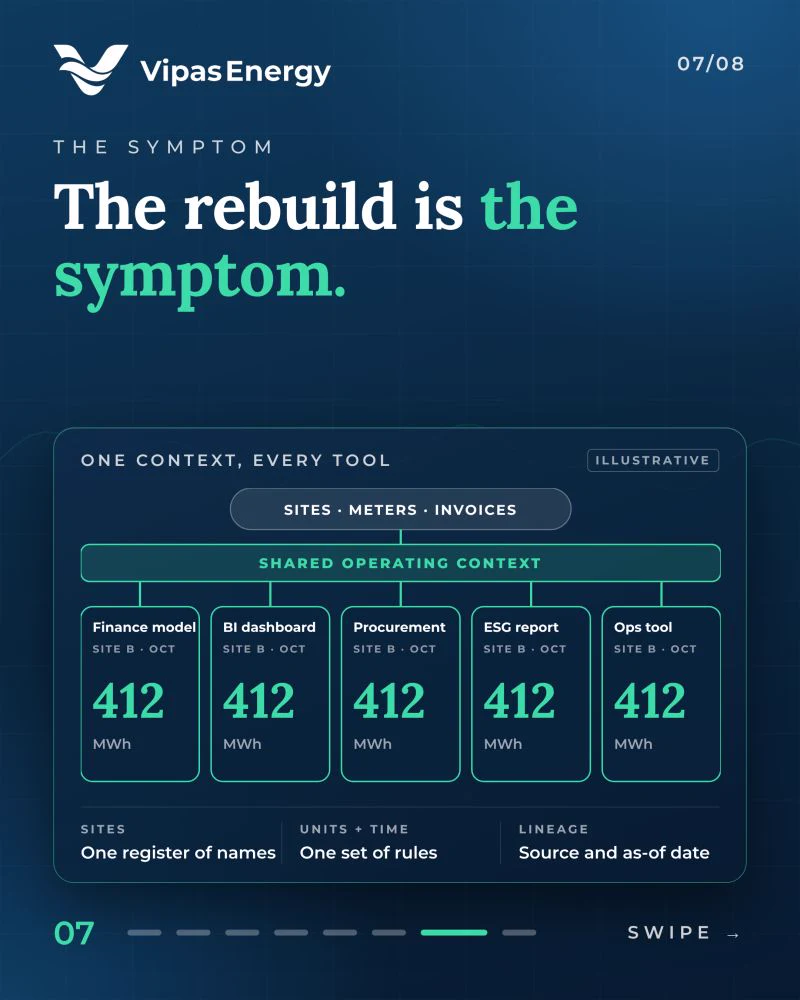
  7. The symptom: the rebuild is the symptom. With one shared operating context, one register of site names, one set of unit and time rules, and source and as-of date on every number, all five tools read 412 MWh. Illustrative.
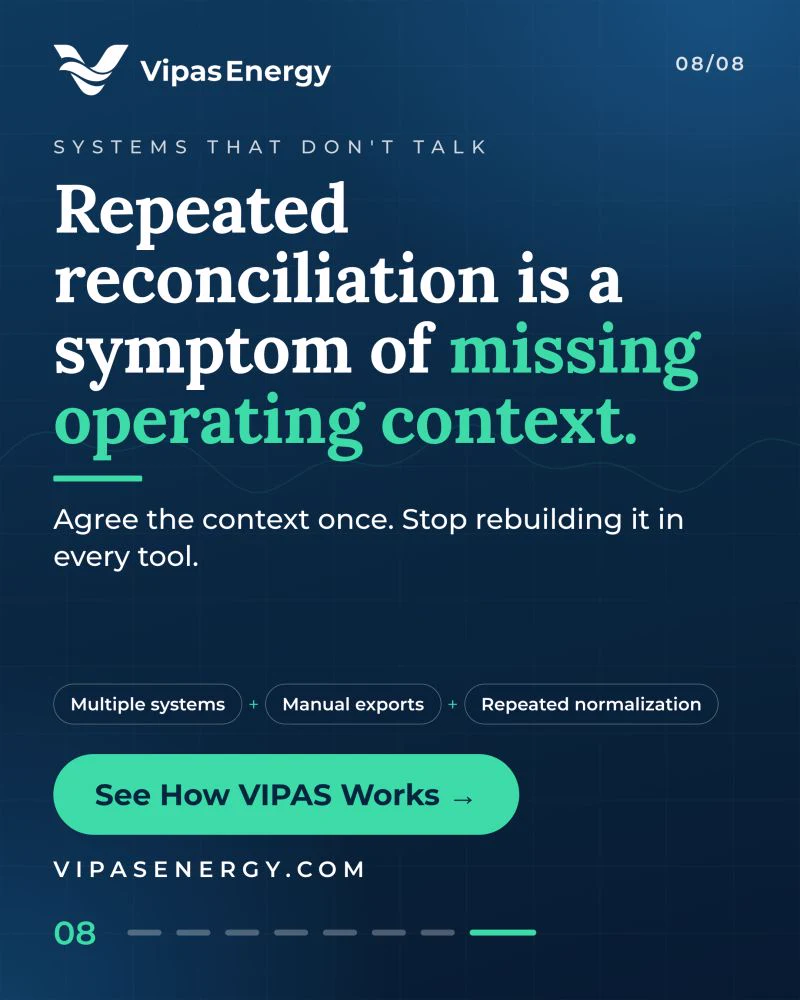
  8. Repeated reconciliation is a symptom of missing operating context. Agree the context once and stop rebuilding it in every tool. See how VIPAS works at vipasenergy.com.

Slide 1 of 8

Open slide 1 full size (opens in a new tab)

The post

How many times did your team rebuild the same energy data this month?

Finance pulls an export for the budget model. The BI team pulls one for the dashboard. Procurement pulls one for the tender. Sustainability pulls one for the report. Operations pulls one for the site review.

Same sites. Same meters. Same invoices. Five copies.

Each team then cleans its copy: maps the site names, converts kWh to MWh, aligns time zones, fills the gaps. The same fixes, five times, with five slightly different rules.

So the same site, in the same month, ends up with five slightly different numbers. And before anyone can decide anything, someone has to reconcile them.

The rebuild isn’t the problem. It’s the symptom.

What’s missing is operating context that is agreed once and read by every tool: one register of site names, one set of rules for units and time, and a record of where each number came from and when.

Repeated reconciliation is a symptom of missing operating context.
  • #EnergyManagement
  • #CIO
  • #DataIntegration
  • #EnergyData
  • #DigitalTransformation

About this post

Published
November 9, 2026
Format
Carousel, 8 slides
Series
Systems That Don’t Talk
Reading time
2 min
  • Open on LinkedIn (opens in a new tab)
  • Follow VIPAS Energy (opens in a new tab)
  • Slide-by-slide transcript ↓
Slide by slide

What each slide says.

A text version of the carousel. Select a thumbnail to show that slide in the viewer above.

  1. Show slide 1 in the viewer
    Slide 01

    Slide 1: Systems That Don't Talk: stop rebuilding the same energy context in five tools. Same sites, same meters, same invoices, rebuilt again in every tool every month: finance model, BI dashboard, procurement, ESG report and ops tool.

  2. Show slide 2 in the viewer
    Slide 02

    Slide 2: The pattern: one set of facts, five copies. The same sites, meters and invoices feed a finance model, BI dashboard, procurement, ESG report and ops tool as five separate copies. Illustrative.

  3. Show slide 3 in the viewer
    Slide 03

    Slide 3: Step 1, export: every tool starts with a manual export, by CSV, email, download or copy-paste, pulled by whoever needs it that week and as of whenever it was pulled. Illustrative.

  4. Show slide 4 in the viewer
    Slide 04

    Slide 4: Step 2, normalize: then each team cleans it again. Every copy repeats the same fixes: site names mapped by hand, kWh converted to MWh, time zones aligned and gaps filled. Illustrative.

  5. Show slide 5 in the viewer
    Slide 05

    Slide 5: Step 3, diverge: five tools, five answers. The same site in the same month reads 412, 409, 415, 398 and 412 MWh across the five tools, because of different exports, rules and pull dates. Illustrative.

  6. Show slide 6 in the viewer
    Slide 06

    Slide 6: Step 4, reconcile: then someone reconciles them. Before anyone can decide, the five different numbers go into a reconciliation sheet asking which one is right. Illustrative.

  7. Show slide 7 in the viewer
    Slide 07

    Slide 7: The symptom: the rebuild is the symptom. With one shared operating context, one register of site names, one set of unit and time rules, and source and as-of date on every number, all five tools read 412 MWh. Illustrative.

  8. Show slide 8 in the viewer
    Slide 08

    Slide 8: Repeated reconciliation is a symptom of missing operating context. Agree the context once and stop rebuilding it in every tool. See how VIPAS works at vipasenergy.com.
← Older postThe rule flags it. People explain it.Newer post →Severe weather changed the baseline. Did your green investment still work?
More from LinkedIn

Keep reading.

All insights →
  • 8 slides

    Systems That Don’t TalkNov 20, 2026

    The data moved. The meaning didn’t.

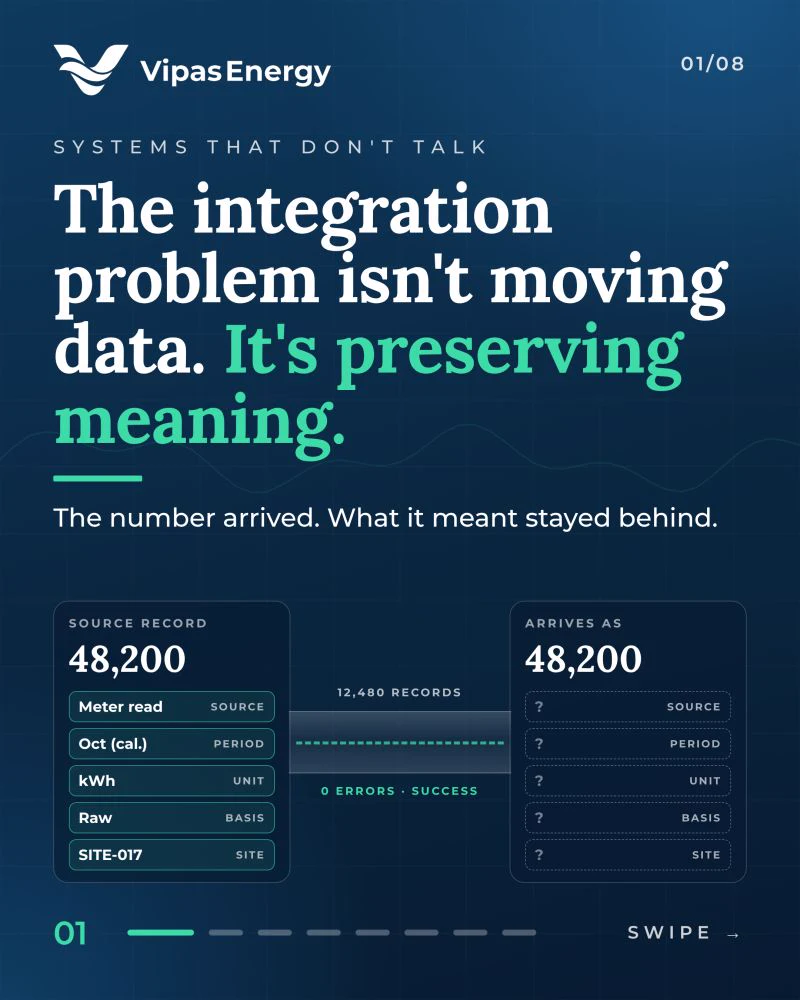
    The nightly load ran with zero errors, yet nobody can say what 48,200 means. Source, calendar, units, normalization and site identity are five labels that need to travel with every number.

    Read post →LinkedIn : The data moved. The meaning didn’t. (opens in a new tab)
  • Article

    Connect, Don’t Replace · NewsletterNov 19, 2026

    Connect, Don’t Replace: What to Demand From an Energy Modernization Program

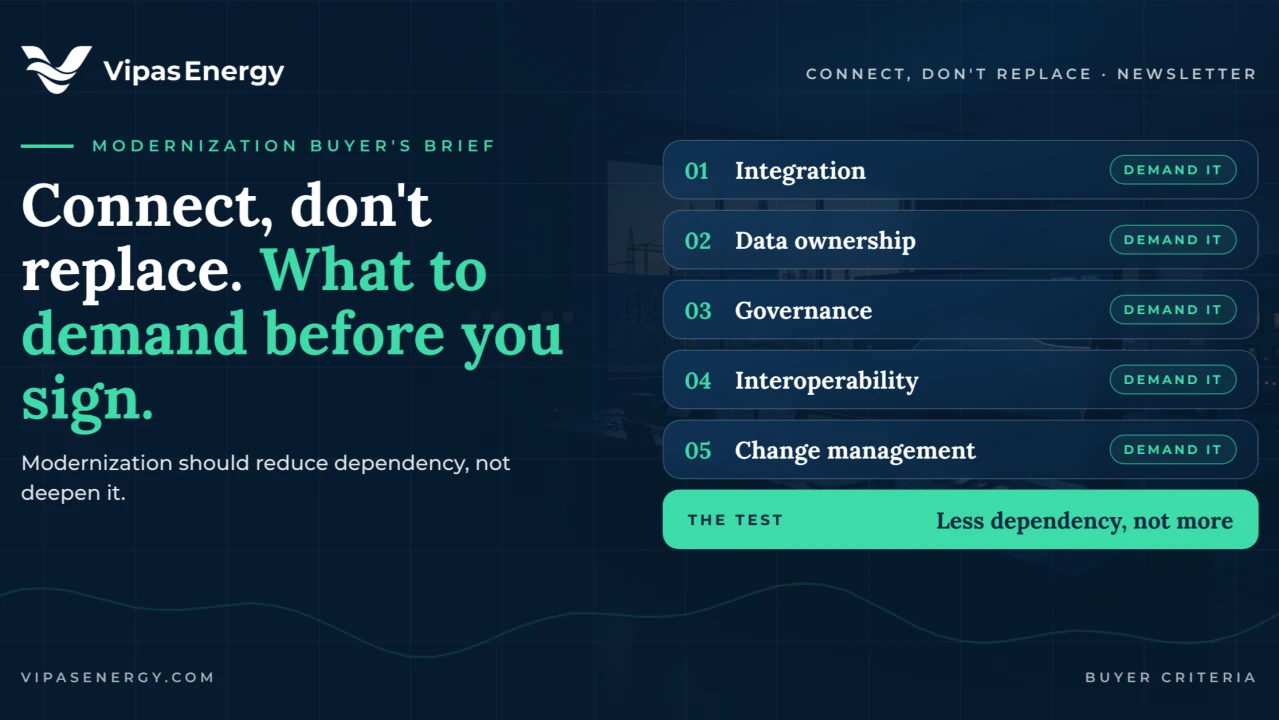
    Most enterprises already run the systems an energy decision needs. Before signing a modernization program, demand five things: integration, data ownership, governance, interoperability and change management.

    Read post →LinkedIn : Connect, Don’t Replace: What to Demand From an Energy Modernization Program (opens in a new tab)
  • 8 slides

    The Decision QuestionNov 18, 2026

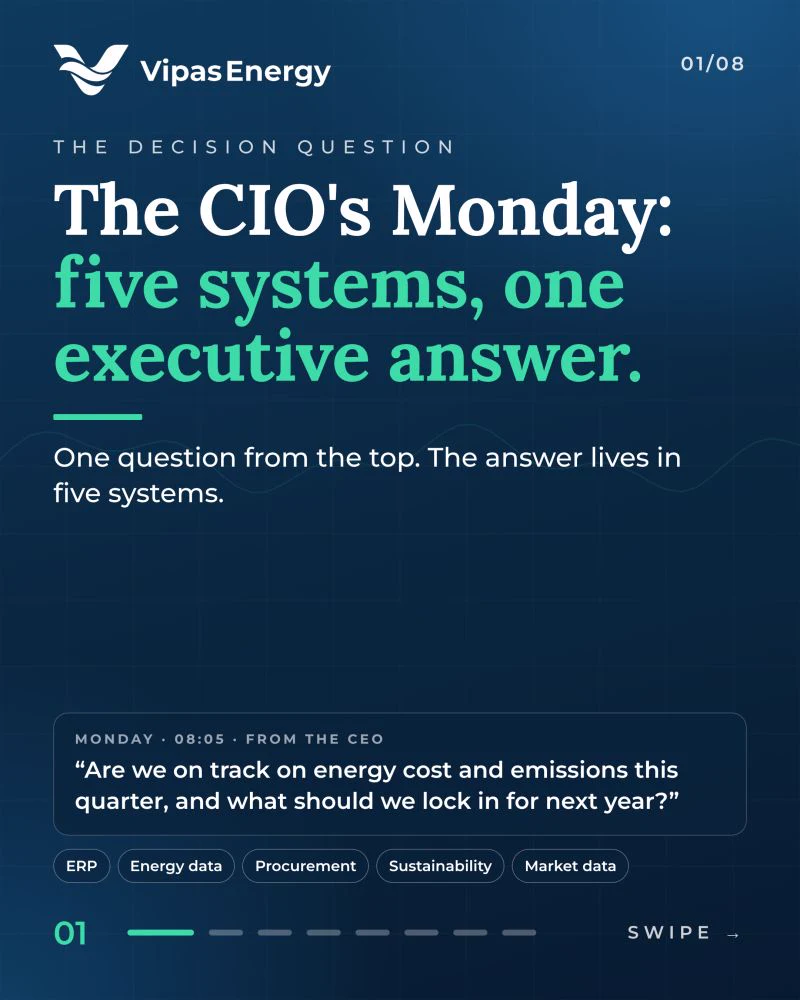
    The CIO’s Monday: five systems, one executive answer.

    One CEO question lives in five systems with five owners and five as-of dates. A new dashboard shows the disagreement faster; trusted context across systems resolves it.

    Read post →LinkedIn : The CIO’s Monday: five systems, one executive answer. (opens in a new tab)
Start with one real workflow

Where is energy fragmentation slowing your team down?

Bring a demand, sourcing, tariff, approval or reconciliation challenge. We’ll explore what a clearer operating path could look like.

Book a discovery conversation →
VIPAS Energy

Building a connected operating layer for modern energy management.

Explore

PlatformCapabilitiesOperating model

Company

About VIPASMedia & InsightsTrust & governanceContact

Use cases

Multi-site demandRates & tariffsApprovalsLinkedIn
© 2026 VIPAS Energy.Connected decisions. Clearer outcomes.