VIPAS Energy
HomePlatformCapabilitiesOperating modelUse casesAbout
Media & InsightsBook a discovery call
  1. Home
  2. Media & Insights
  3. The data moved
Systems That Don’t Talk

The data moved. The meaning didn’t.

The nightly load ran with zero errors, yet nobody can say what 48,200 means. Source, calendar, units, normalization and site identity are five labels that need to travel with every number.

  • November 20, 2026
  • Carousel
  • 8 slides
  • 2 min read
View on LinkedIn (opens in a new tab)Share on LinkedIn (opens in a new tab)

Carousel slides: The data moved. The meaning didn’t.

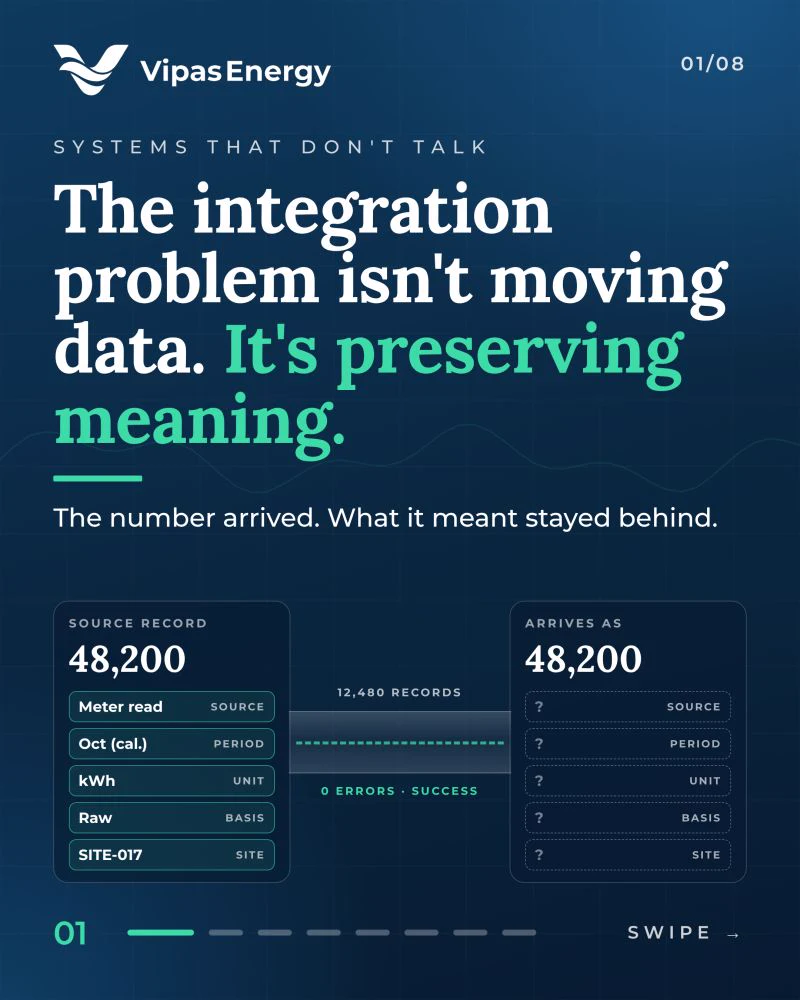
  1. Systems That Don't Talk: the integration problem isn't moving data, it's preserving meaning. A source record of 48,200 arrives as 48,200, but its source, period, unit, basis and site labels stay behind.
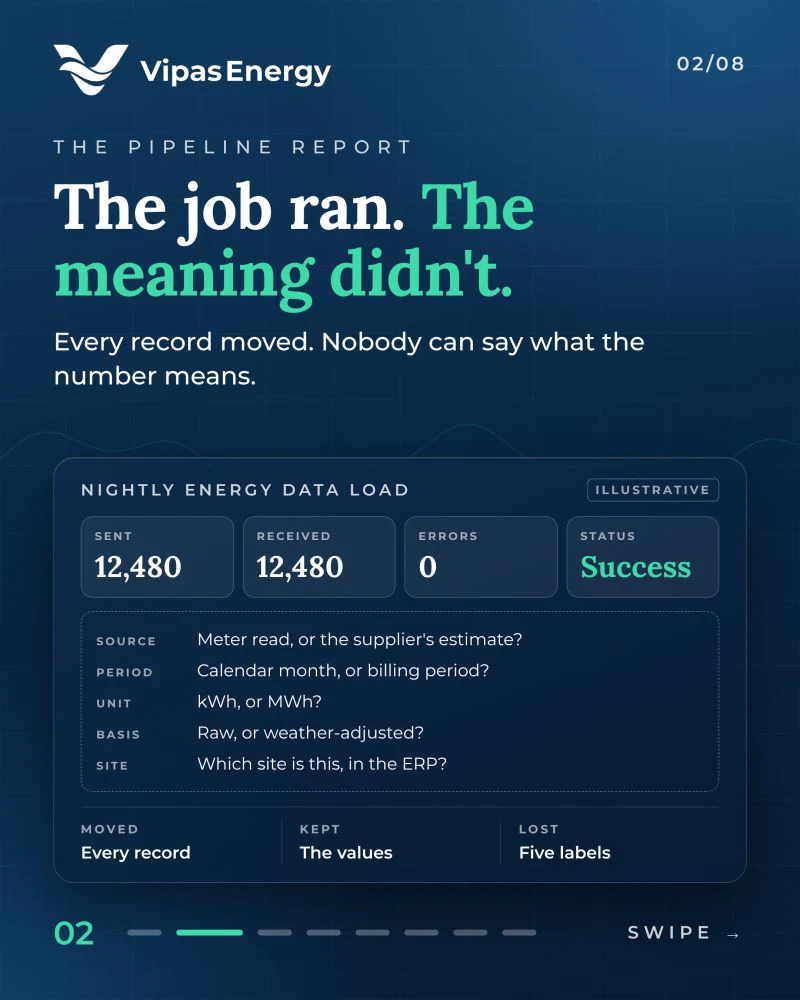
  2. The pipeline report: the job ran, the meaning didn't. An illustrative nightly load shows 12,480 records sent and received with zero errors, yet nobody can say what the numbers mean.
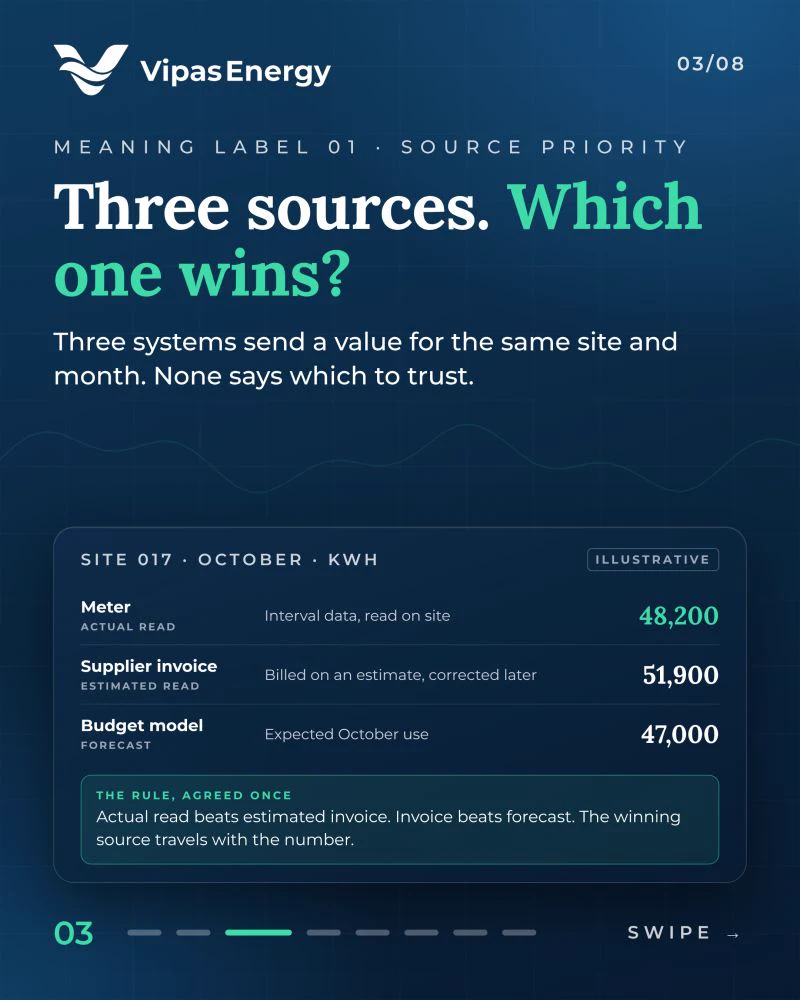
  3. Meaning label 1, source priority: three sources, which one wins? A meter read, a supplier invoice and a budget model give different October values for the same site. Agreed rule: actual read beats estimated invoice, invoice beats forecast.
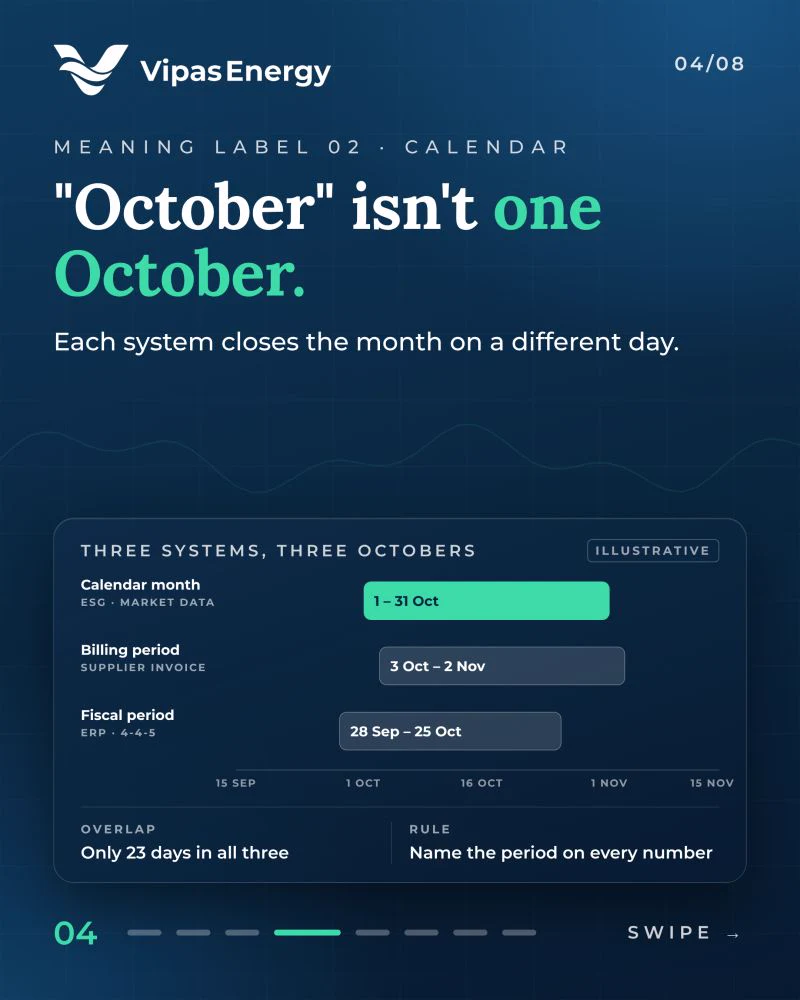
  4. Meaning label 2, calendar: "October" isn't one October. Calendar month, billing period and fiscal period overlap by only 23 days, so name the period on every number.
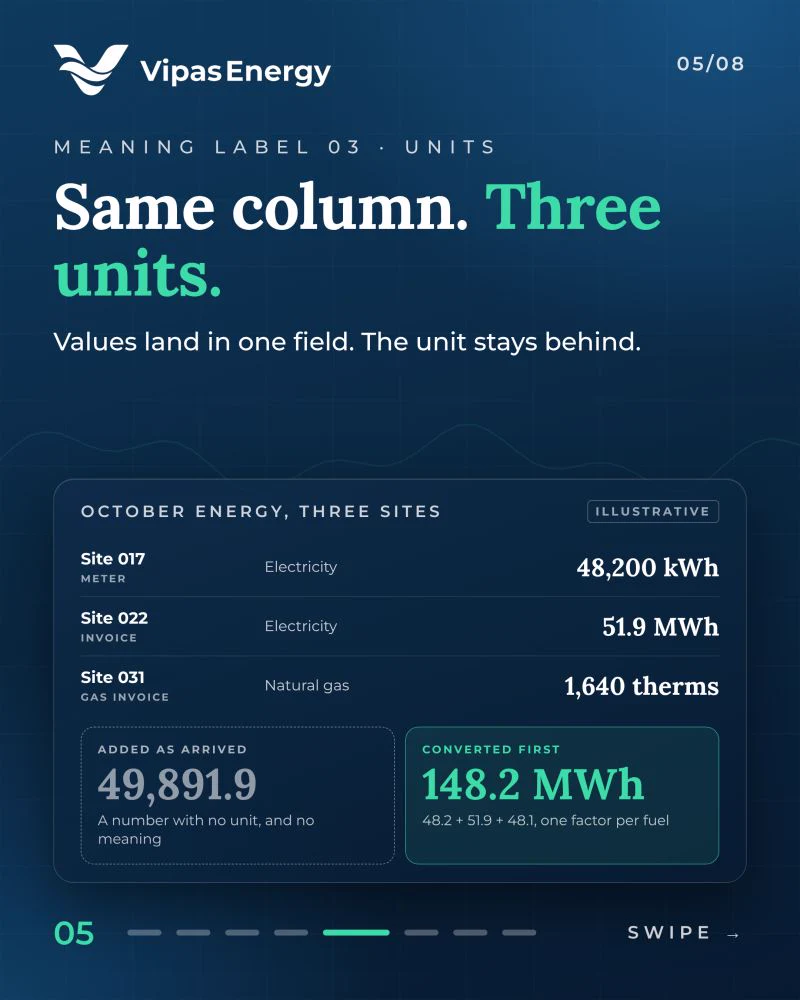
  5. Meaning label 3, units: same column, three units. kWh, MWh and therms added as they arrive give a meaningless 49,891.9; converted first, they total 148.2 MWh.
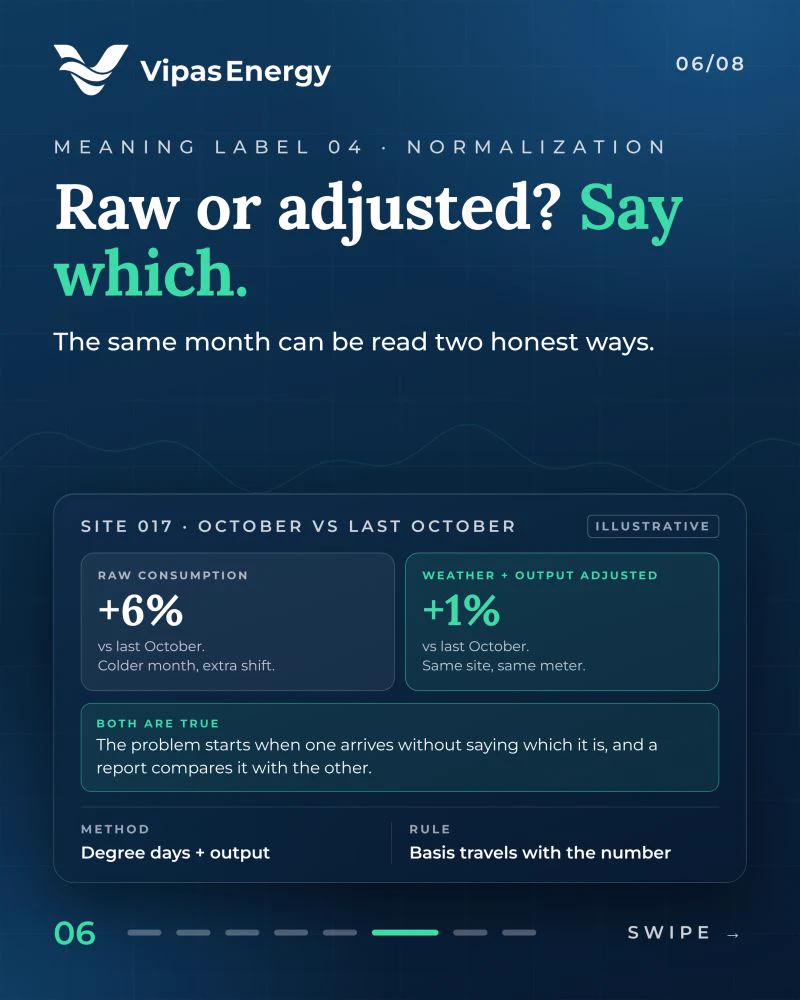
  6. Meaning label 4, normalization: raw or adjusted? Say which. The same month reads +6% raw and +1% weather and output adjusted; both are true, so the basis must travel with the number.
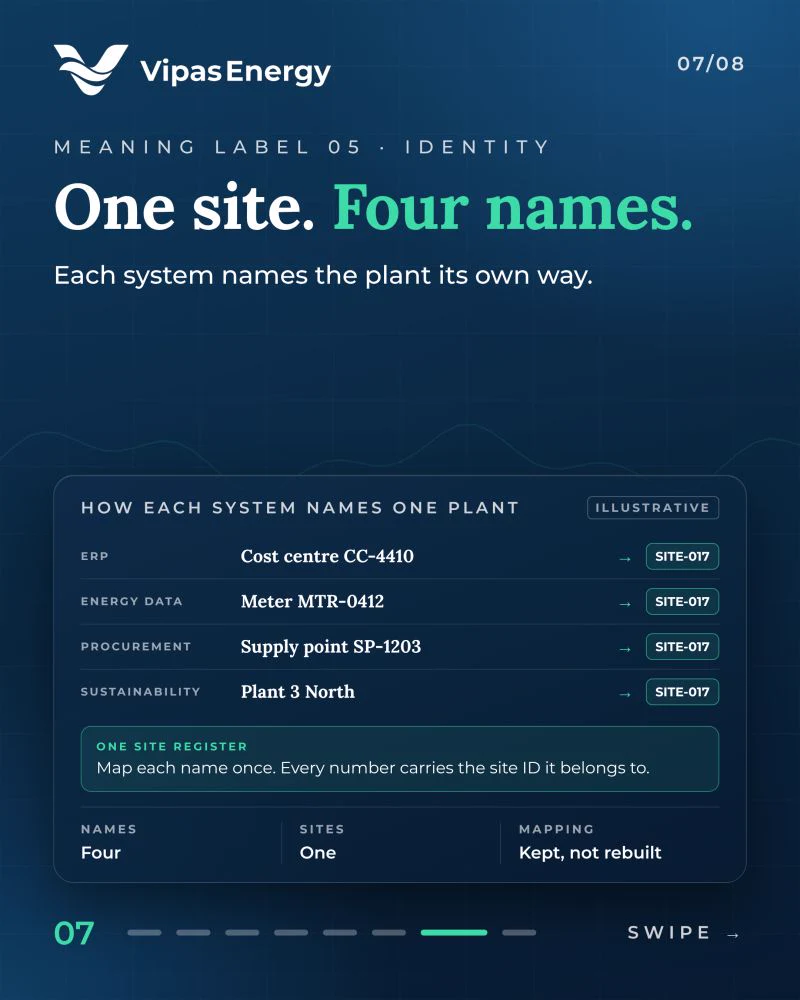
  7. Meaning label 5, identity: one site, four names. ERP, energy data, procurement and sustainability systems each name the plant differently; one site register maps every name to a single site ID.
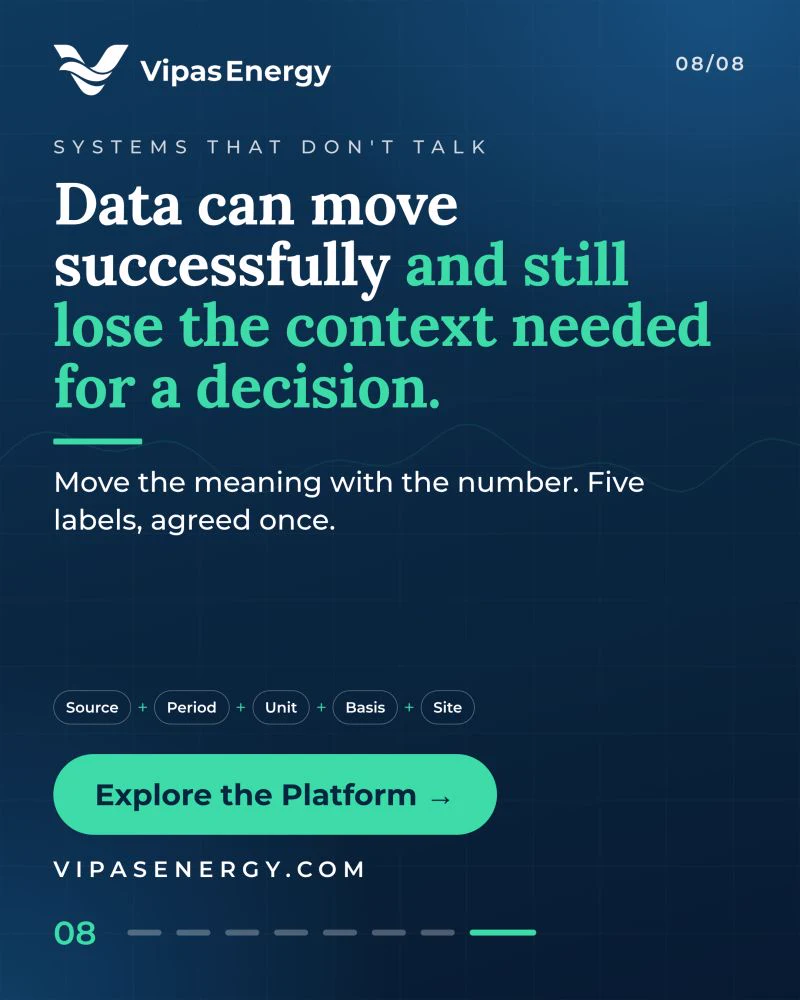
  8. Data can move successfully and still lose the context needed for a decision. Move the meaning with the number: source, period, unit, basis and site, agreed once. Explore the platform at vipasenergy.com.

Slide 1 of 8

Open slide 1 full size (opens in a new tab)

The post

The nightly load ran. 12,480 records sent, 12,480 received, zero errors.

And nobody can say what 48,200 means.

Was it a meter read or the supplier’s estimate? Calendar October, or a billing period that ran 3 October to 2 November? kWh or MWh? Raw, or weather-adjusted? And which site is it in the ERP, where the same plant is cost centre CC-4410?

The data moved. The meaning didn’t.

Most integration problems look like this. Not a broken pipe, but five labels that stayed behind:

1. Source priority: which source wins when two disagree 2. Calendar: which “October” the number belongs to 3. Units: what it is measured in, and how it converts 4. Normalization: raw or adjusted, and on what basis 5. Identity: which site, on one shared register

Agree those once, and every number can carry them wherever it goes.

Data can move successfully and still lose the context needed for a decision.

NoteAll figures are illustrative.
  • #CIO
  • #EnergyData
  • #DataGovernance
  • #DataIntegration
  • #EnergyManagement

About this post

Published
November 20, 2026
Format
Carousel, 8 slides
Series
Systems That Don’t Talk
Reading time
2 min
  • Open on LinkedIn (opens in a new tab)
  • Follow VIPAS Energy (opens in a new tab)
  • Slide-by-slide transcript ↓
Slide by slide

What each slide says.

A text version of the carousel. Select a thumbnail to show that slide in the viewer above.

  1. Show slide 1 in the viewer
    Slide 01

    Slide 1: Systems That Don't Talk: the integration problem isn't moving data, it's preserving meaning. A source record of 48,200 arrives as 48,200, but its source, period, unit, basis and site labels stay behind.

  2. Show slide 2 in the viewer
    Slide 02

    Slide 2: The pipeline report: the job ran, the meaning didn't. An illustrative nightly load shows 12,480 records sent and received with zero errors, yet nobody can say what the numbers mean.

  3. Show slide 3 in the viewer
    Slide 03

    Slide 3: Meaning label 1, source priority: three sources, which one wins? A meter read, a supplier invoice and a budget model give different October values for the same site. Agreed rule: actual read beats estimated invoice, invoice beats forecast.

  4. Show slide 4 in the viewer
    Slide 04

    Slide 4: Meaning label 2, calendar: "October" isn't one October. Calendar month, billing period and fiscal period overlap by only 23 days, so name the period on every number.

  5. Show slide 5 in the viewer
    Slide 05

    Slide 5: Meaning label 3, units: same column, three units. kWh, MWh and therms added as they arrive give a meaningless 49,891.9; converted first, they total 148.2 MWh.

  6. Show slide 6 in the viewer
    Slide 06

    Slide 6: Meaning label 4, normalization: raw or adjusted? Say which. The same month reads +6% raw and +1% weather and output adjusted; both are true, so the basis must travel with the number.

  7. Show slide 7 in the viewer
    Slide 07

    Slide 7: Meaning label 5, identity: one site, four names. ERP, energy data, procurement and sustainability systems each name the plant differently; one site register maps every name to a single site ID.

  8. Show slide 8 in the viewer
    Slide 08

    Slide 8: Data can move successfully and still lose the context needed for a decision. Move the meaning with the number: source, period, unit, basis and site, agreed once. Explore the platform at vipasenergy.com.

← Older postConnect, Don’t Replace: What to Demand From an Energy Modernization ProgramYou’re reading the latestBrowse all insights →
More from LinkedIn

Keep reading.

All insights →
  • Article

    Connect, Don’t Replace · NewsletterNov 19, 2026

    Connect, Don’t Replace: What to Demand From an Energy Modernization Program

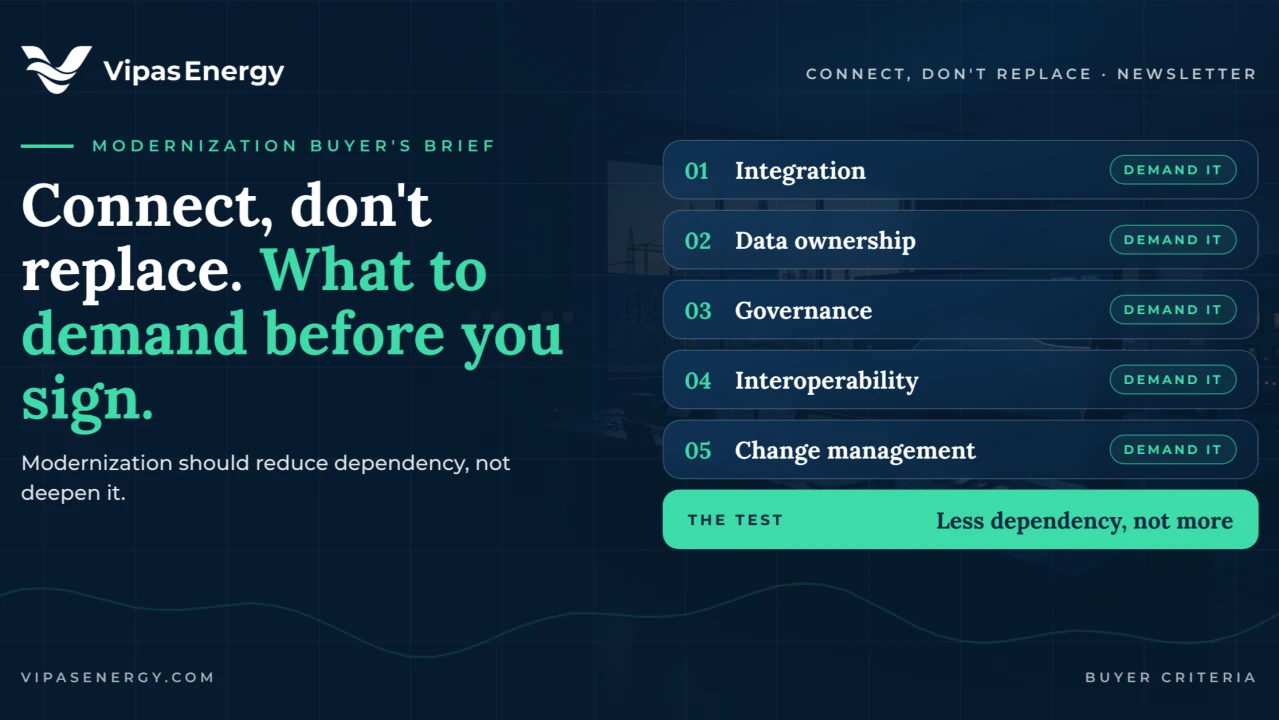
    Most enterprises already run the systems an energy decision needs. Before signing a modernization program, demand five things: integration, data ownership, governance, interoperability and change management.

    Read post →LinkedIn : Connect, Don’t Replace: What to Demand From an Energy Modernization Program (opens in a new tab)
  • 8 slides

    The Decision QuestionNov 18, 2026

    The CIO’s Monday: five systems, one executive answer.

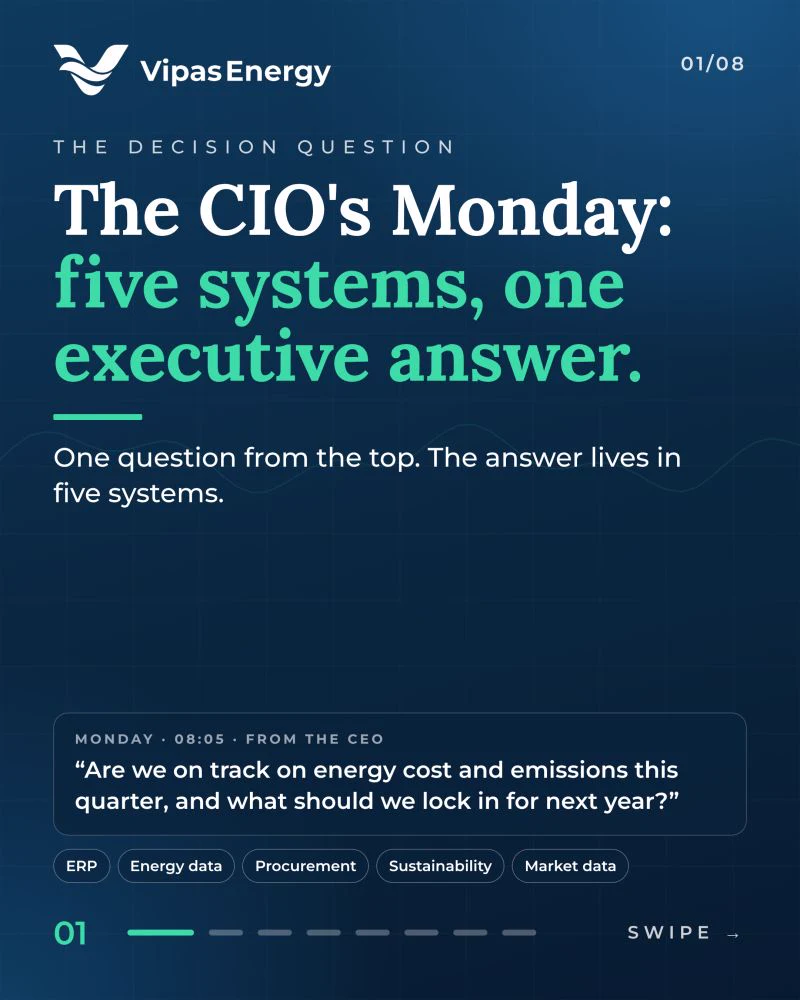
    One CEO question lives in five systems with five owners and five as-of dates. A new dashboard shows the disagreement faster; trusted context across systems resolves it.

    Read post →LinkedIn : The CIO’s Monday: five systems, one executive answer. (opens in a new tab)
  • Article

    Connect, Don’t Replace · From the BlogNov 12, 2026

    Connect, Don’t Replace: The Case for an Intelligence Layer Above Existing Energy Systems

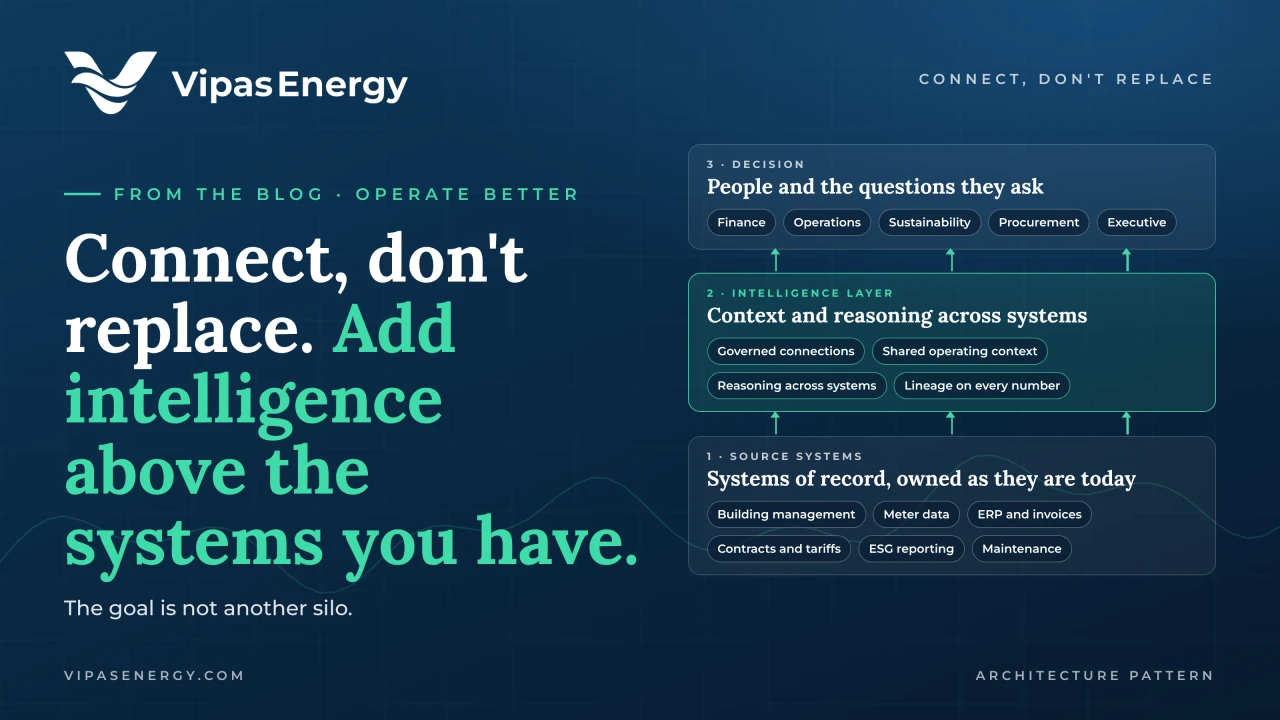
    Replace the systems, add another silo, or add a layer. An intelligence layer leaves systems of record in place, holds shared context once and traces every number to its source.

    Read post →LinkedIn : Connect, Don’t Replace: The Case for an Intelligence Layer Above Existing Energy Systems (opens in a new tab)
Start with one real workflow

Where is energy fragmentation slowing your team down?

Bring a demand, sourcing, tariff, approval or reconciliation challenge. We’ll explore what a clearer operating path could look like.

Book a discovery conversation →
VIPAS Energy

Building a connected operating layer for modern energy management.

Explore

PlatformCapabilitiesOperating model

Company

About VIPASMedia & InsightsTrust & governanceContact

Use cases

Multi-site demandRates & tariffsApprovalsLinkedIn
© 2026 VIPAS Energy.Connected decisions. Clearer outcomes.