VIPAS Energy
HomePlatformCapabilitiesOperating modelUse casesAbout
Media & InsightsBook a discovery call
  1. Home
  2. Media & Insights
  3. The CIO’s Monday: five systems, one…
The Decision Question

The CIO’s Monday: five systems, one executive answer.

One CEO question lives in five systems with five owners and five as-of dates. A new dashboard shows the disagreement faster; trusted context across systems resolves it.

  • November 18, 2026
  • Carousel
  • 8 slides
  • 2 min read
View on LinkedIn (opens in a new tab)Share on LinkedIn (opens in a new tab)

Carousel slides: The CIO’s Monday: five systems, one executive answer.

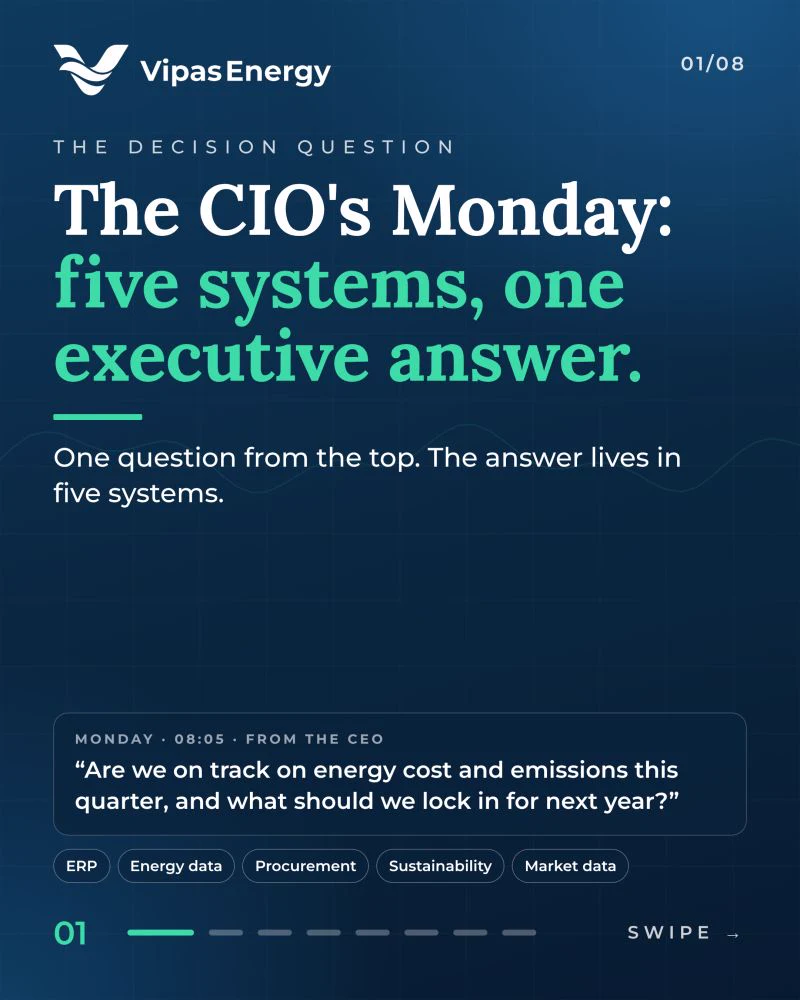
  1. The Decision Question: the CIO's Monday, five systems, one executive answer. The CEO asks whether energy cost and emissions are on track this quarter and what to lock in for next year; the answer lives in the ERP, energy data, procurement, sustainability and market data.
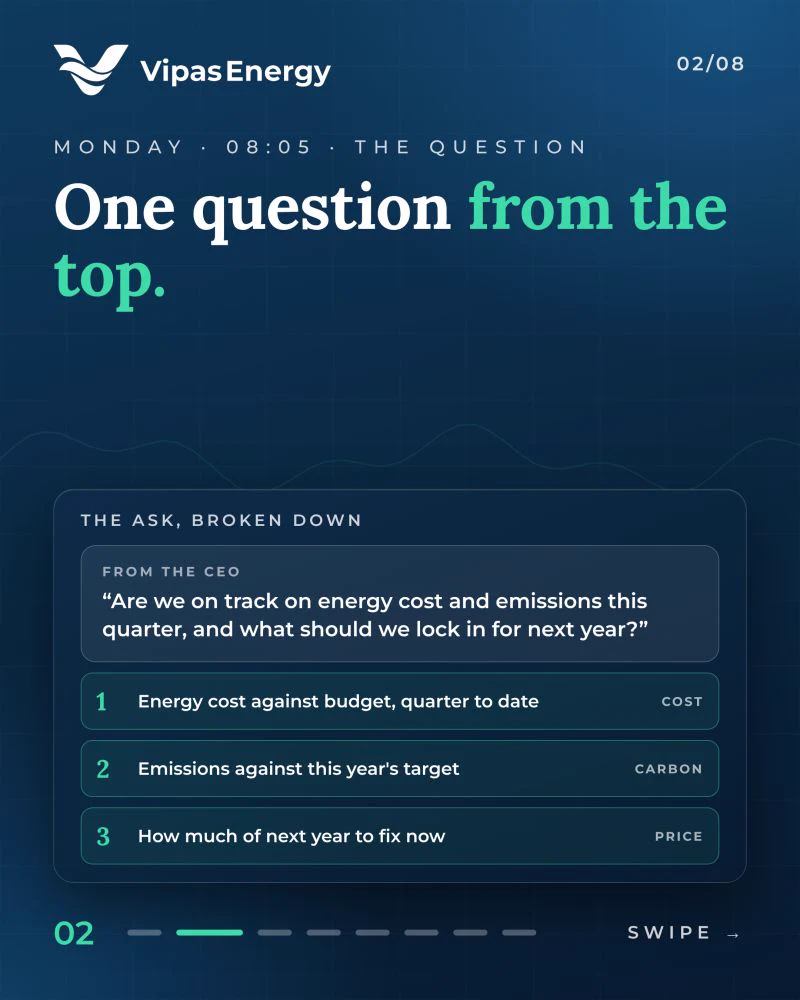
  2. Monday 08:05, the question: one question from the top, broken into three parts: energy cost against budget quarter to date, emissions against this year's target, and how much of next year to fix now.
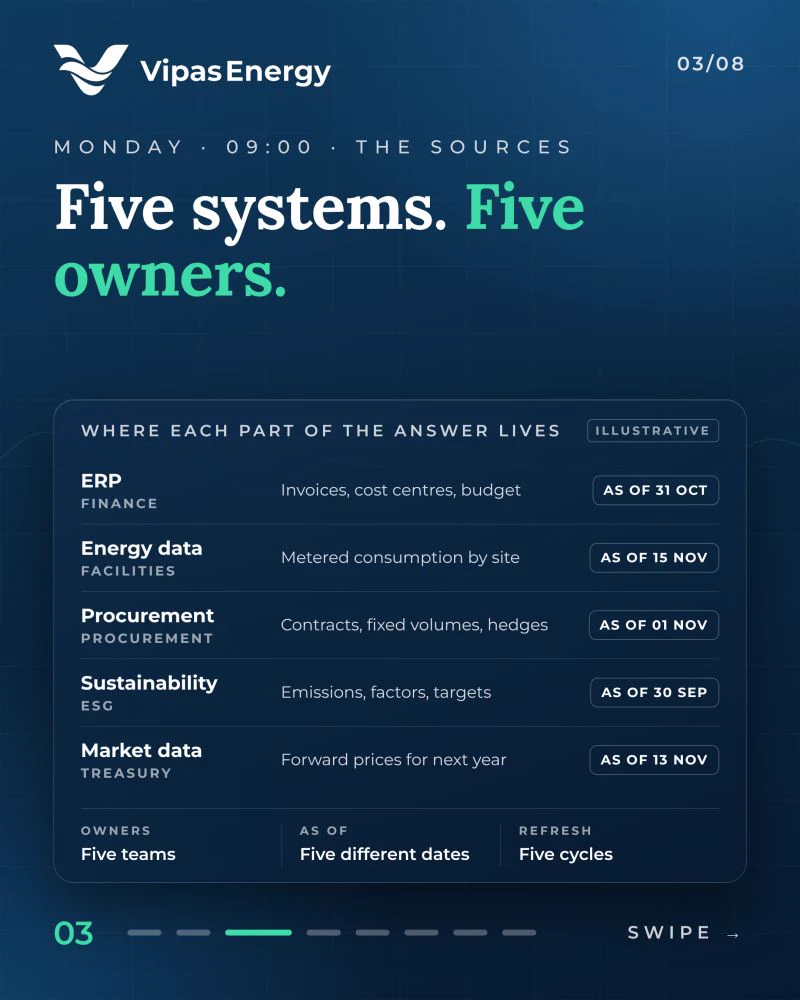
  3. Monday 09:00, the sources: five systems, five owners. ERP, energy data, procurement, sustainability and market data each hold part of the answer, with five different as-of dates and five refresh cycles. Illustrative.
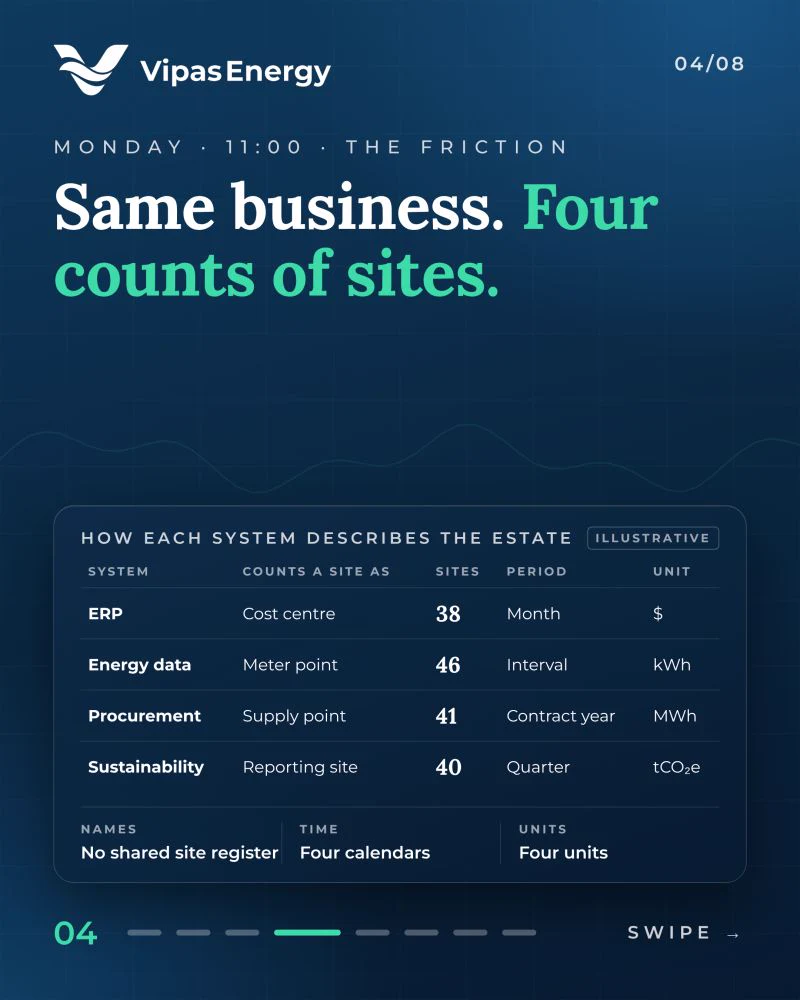
  4. Monday 11:00, the friction: same business, four counts of sites. The ERP counts 38, energy data 46, procurement 41 and sustainability 40, each with its own period and unit and no shared site register. Illustrative.
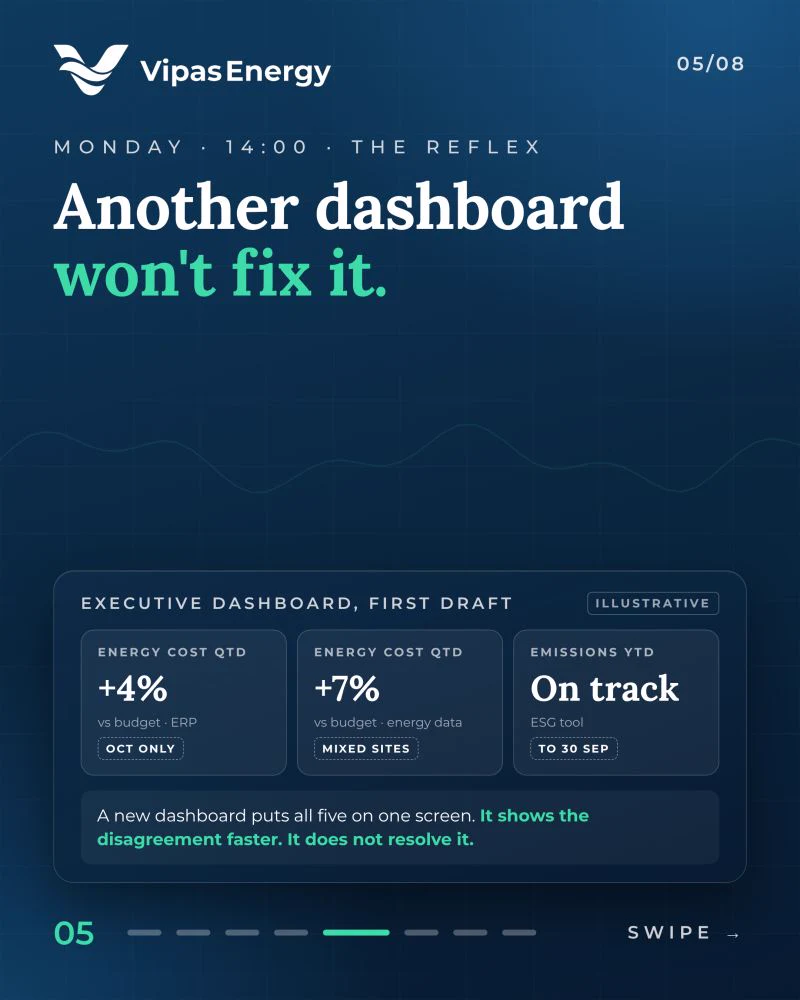
  5. Monday 14:00, the reflex: another dashboard won't fix it. A first-draft executive dashboard shows energy cost +4% and +7% from two sources and emissions on track to a different date; it shows the disagreement faster but does not resolve it.
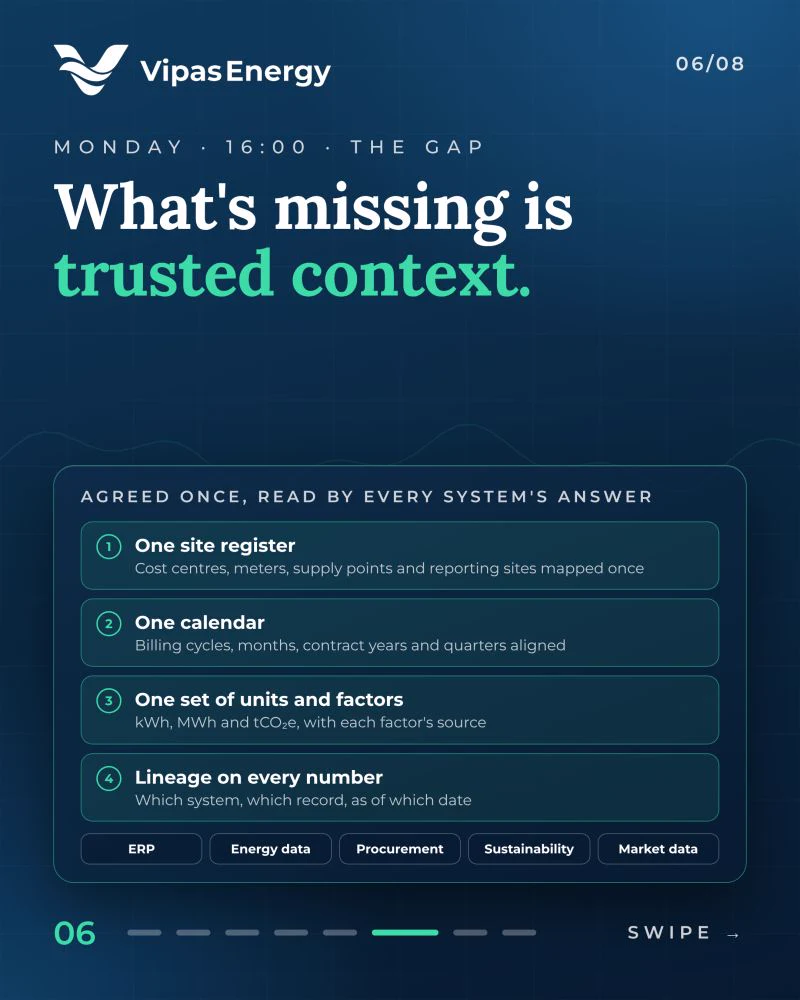
  6. Monday 16:00, the gap: what's missing is trusted context. Agreed once and read by every system: one site register, one calendar, one set of units and factors, and lineage on every number.
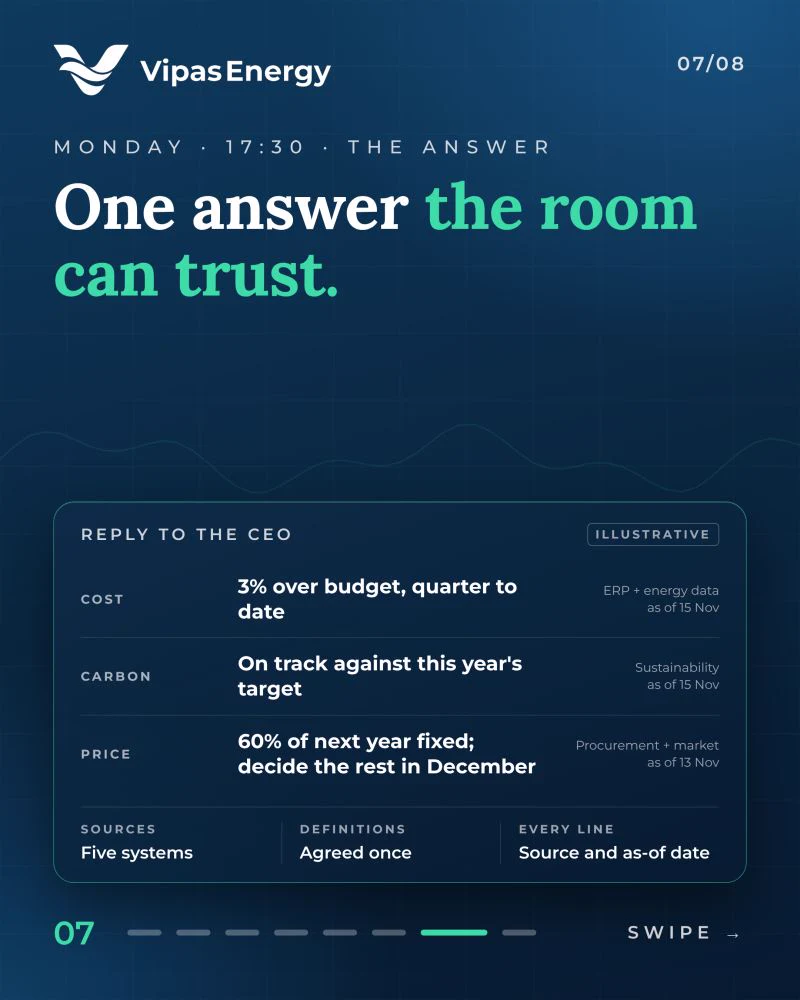
  7. Monday 17:30, the answer: one answer the room can trust. Reply to the CEO: cost 3% over budget quarter to date, carbon on track against this year's target, 60% of next year fixed with the rest decided in December, each with its source and as-of date. Illustrative.
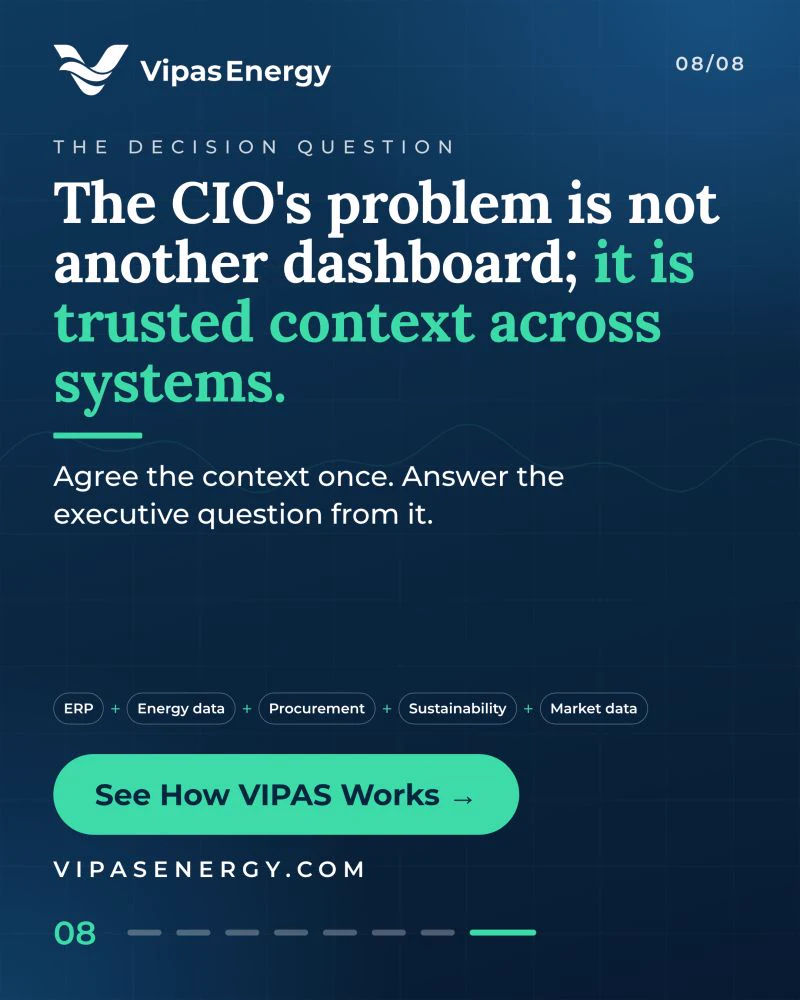
  8. The CIO's problem is not another dashboard; it is trusted context across systems. Agree the context once and answer the executive question from it. See how VIPAS works at vipasenergy.com.

Slide 1 of 8

Open slide 1 full size (opens in a new tab)

The post

Monday, 08:05. The CEO asks one question:

“Are we on track on energy cost and emissions this quarter, and what should we lock in for next year?”

It sounds like one question. It lives in five systems: the ERP, the energy data platform, procurement, the sustainability tool and market data. Five owners. Five as-of dates.

By 11:00 they don’t agree. The ERP counts 38 sites, the meters 46, procurement 41, the ESG tool 40. One reports monthly, one by interval, one by contract year, one by quarter.

By 14:00 someone suggests a new dashboard. It puts all five on one screen, and shows the disagreement faster. It doesn’t resolve it.

What’s missing is trusted context: one site register, one calendar, one set of units and factors, and the source and as-of date on every number.

With that agreed once, the 17:30 reply is three lines the room can trust: cost against budget, emissions against target, and how much of next year is already fixed. Each with its source.

The CIO’s problem is not another dashboard; it is trusted context across systems.

NoteAll figures are illustrative.
  • #CIO
  • #EnergyManagement
  • #DataGovernance
  • #EnergyData
  • #DigitalTransformation

About this post

Published
November 18, 2026
Format
Carousel, 8 slides
Series
The Decision Question
Reading time
2 min
  • Open on LinkedIn (opens in a new tab)
  • Follow VIPAS Energy (opens in a new tab)
  • Slide-by-slide transcript ↓
Slide by slide

What each slide says.

A text version of the carousel. Select a thumbnail to show that slide in the viewer above.

  1. Show slide 1 in the viewer
    Slide 01

    Slide 1: The Decision Question: the CIO's Monday, five systems, one executive answer. The CEO asks whether energy cost and emissions are on track this quarter and what to lock in for next year; the answer lives in the ERP, energy data, procurement, sustainability and market data.

  2. Show slide 2 in the viewer
    Slide 02

    Slide 2: Monday 08:05, the question: one question from the top, broken into three parts: energy cost against budget quarter to date, emissions against this year's target, and how much of next year to fix now.

  3. Show slide 3 in the viewer
    Slide 03

    Slide 3: Monday 09:00, the sources: five systems, five owners. ERP, energy data, procurement, sustainability and market data each hold part of the answer, with five different as-of dates and five refresh cycles. Illustrative.

  4. Show slide 4 in the viewer
    Slide 04

    Slide 4: Monday 11:00, the friction: same business, four counts of sites. The ERP counts 38, energy data 46, procurement 41 and sustainability 40, each with its own period and unit and no shared site register. Illustrative.

  5. Show slide 5 in the viewer
    Slide 05

    Slide 5: Monday 14:00, the reflex: another dashboard won't fix it. A first-draft executive dashboard shows energy cost +4% and +7% from two sources and emissions on track to a different date; it shows the disagreement faster but does not resolve it.

  6. Show slide 6 in the viewer
    Slide 06

    Slide 6: Monday 16:00, the gap: what's missing is trusted context. Agreed once and read by every system: one site register, one calendar, one set of units and factors, and lineage on every number.

  7. Show slide 7 in the viewer
    Slide 07

    Slide 7: Monday 17:30, the answer: one answer the room can trust. Reply to the CEO: cost 3% over budget quarter to date, carbon on track against this year's target, 60% of next year fixed with the rest decided in December, each with its source and as-of date. Illustrative.

  8. Show slide 8 in the viewer
    Slide 08

    Slide 8: The CIO's problem is not another dashboard; it is trusted context across systems. Agree the context once and answer the executive question from it. See how VIPAS works at vipasenergy.com.

← Older postConnect, Don’t Replace: The Case for an Intelligence Layer Above Existing Energy SystemsNewer post →Connect, Don’t Replace: What to Demand From an Energy Modernization Program
More from LinkedIn

Keep reading.

All insights →
  • 8 slides

    Systems That Don’t TalkNov 20, 2026

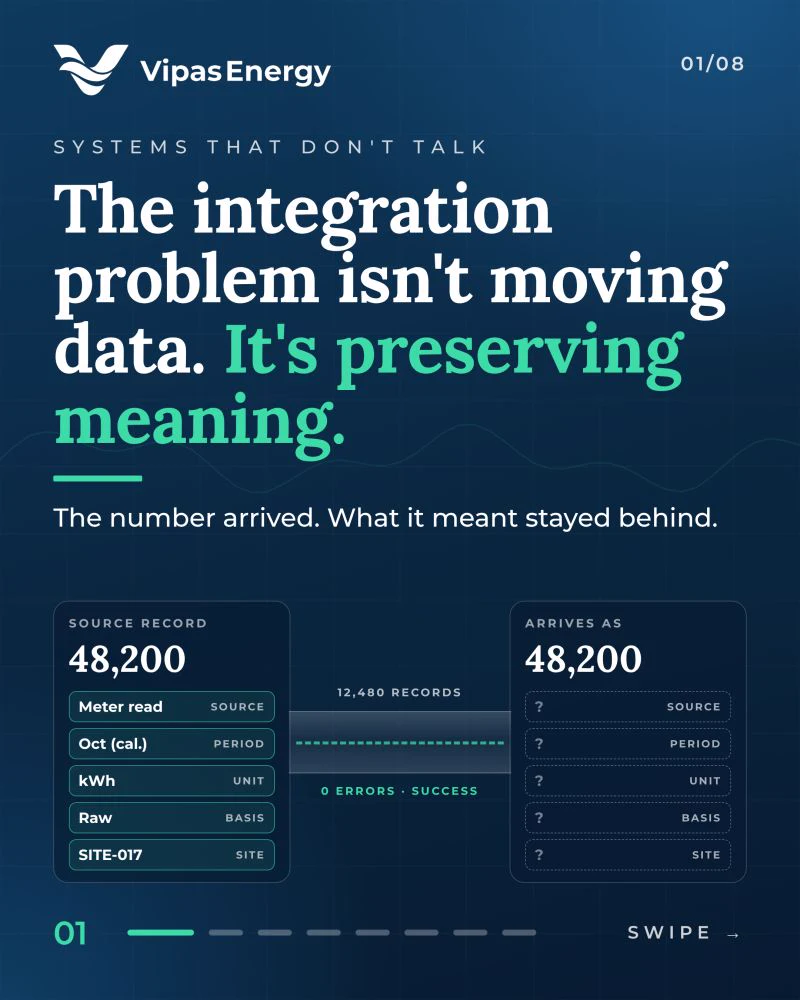
    The data moved. The meaning didn’t.

    The nightly load ran with zero errors, yet nobody can say what 48,200 means. Source, calendar, units, normalization and site identity are five labels that need to travel with every number.

    Read post →LinkedIn : The data moved. The meaning didn’t. (opens in a new tab)
  • Article

    Connect, Don’t Replace · NewsletterNov 19, 2026

    Connect, Don’t Replace: What to Demand From an Energy Modernization Program

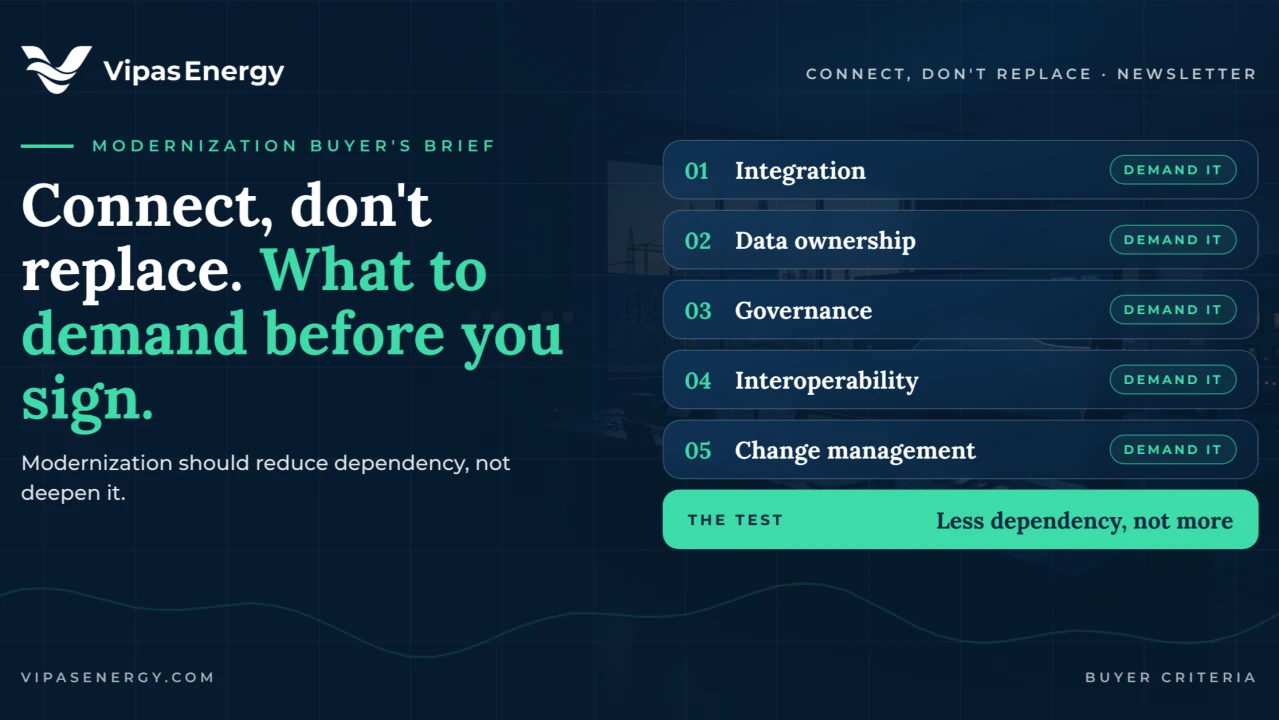
    Most enterprises already run the systems an energy decision needs. Before signing a modernization program, demand five things: integration, data ownership, governance, interoperability and change management.

    Read post →LinkedIn : Connect, Don’t Replace: What to Demand From an Energy Modernization Program (opens in a new tab)
  • Article

    Connect, Don’t Replace · From the BlogNov 12, 2026

    Connect, Don’t Replace: The Case for an Intelligence Layer Above Existing Energy Systems

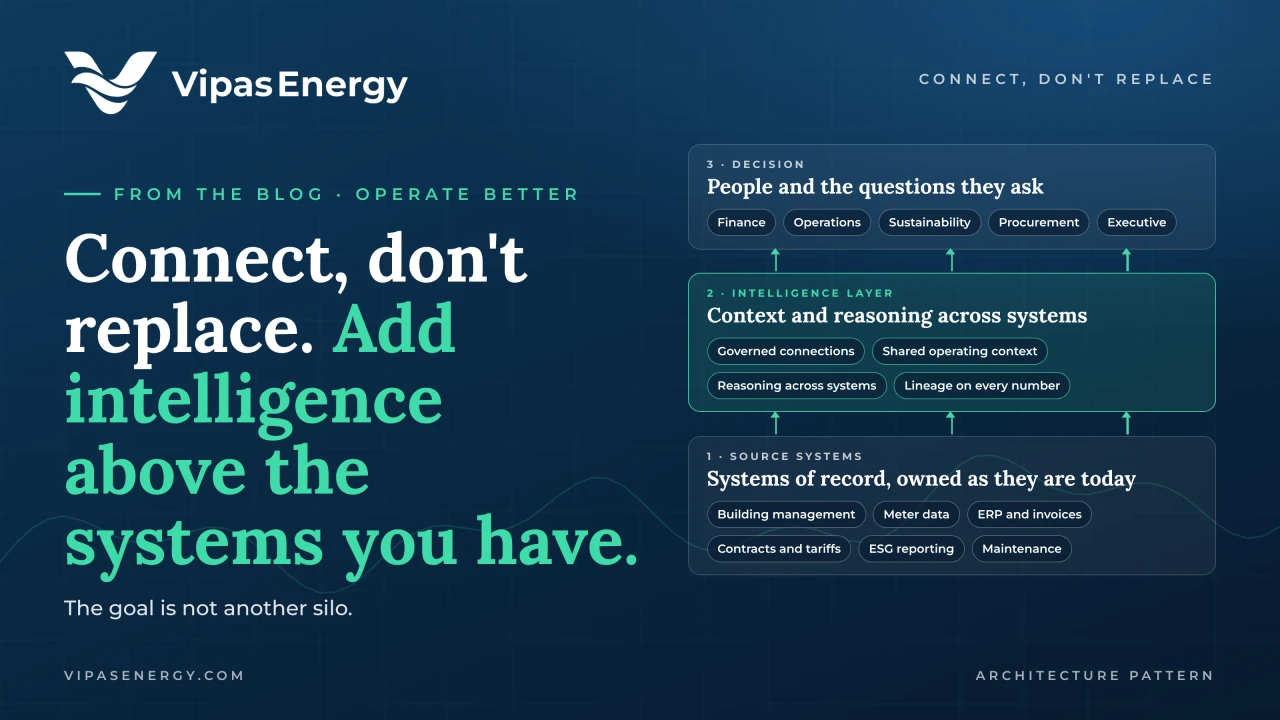
    Replace the systems, add another silo, or add a layer. An intelligence layer leaves systems of record in place, holds shared context once and traces every number to its source.

    Read post →LinkedIn : Connect, Don’t Replace: The Case for an Intelligence Layer Above Existing Energy Systems (opens in a new tab)
Start with one real workflow

Where is energy fragmentation slowing your team down?

Bring a demand, sourcing, tariff, approval or reconciliation challenge. We’ll explore what a clearer operating path could look like.

Book a discovery conversation →
VIPAS Energy

Building a connected operating layer for modern energy management.

Explore

PlatformCapabilitiesOperating model

Company

About VIPASMedia & InsightsTrust & governanceContact

Use cases

Multi-site demandRates & tariffsApprovalsLinkedIn
© 2026 VIPAS Energy.Connected decisions. Clearer outcomes.