VIPAS Energy
HomePlatformCapabilitiesOperating modelUse casesAbout
Media & InsightsBook a discovery call
  1. Home
  2. Media & Insights
  3. Your institutional energy process is an…
Connect, Don’t Replace

Your institutional energy process is an asset, not technical debt.

A working energy approval chain holds controls tested by audit and experience. The slow part is the handoffs between steps, so connect those rather than replacing the process and resetting its thresholds, ownership and history.

  • November 2, 2026
  • Carousel
  • 8 slides
  • 2 min read
View on LinkedIn (opens in a new tab)Share on LinkedIn (opens in a new tab)

Carousel slides: Your institutional energy process is an asset, not technical debt.

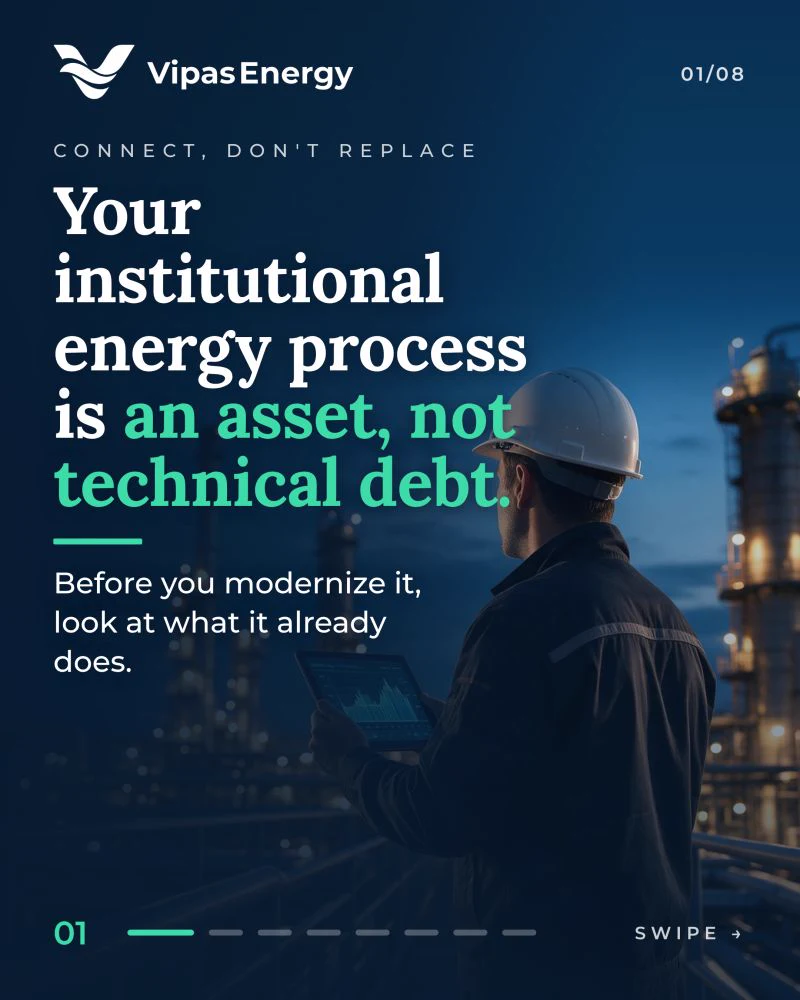
  1. Connect, don't replace: your institutional energy process is an asset, not technical debt. Before you modernize it, look at what it already does.
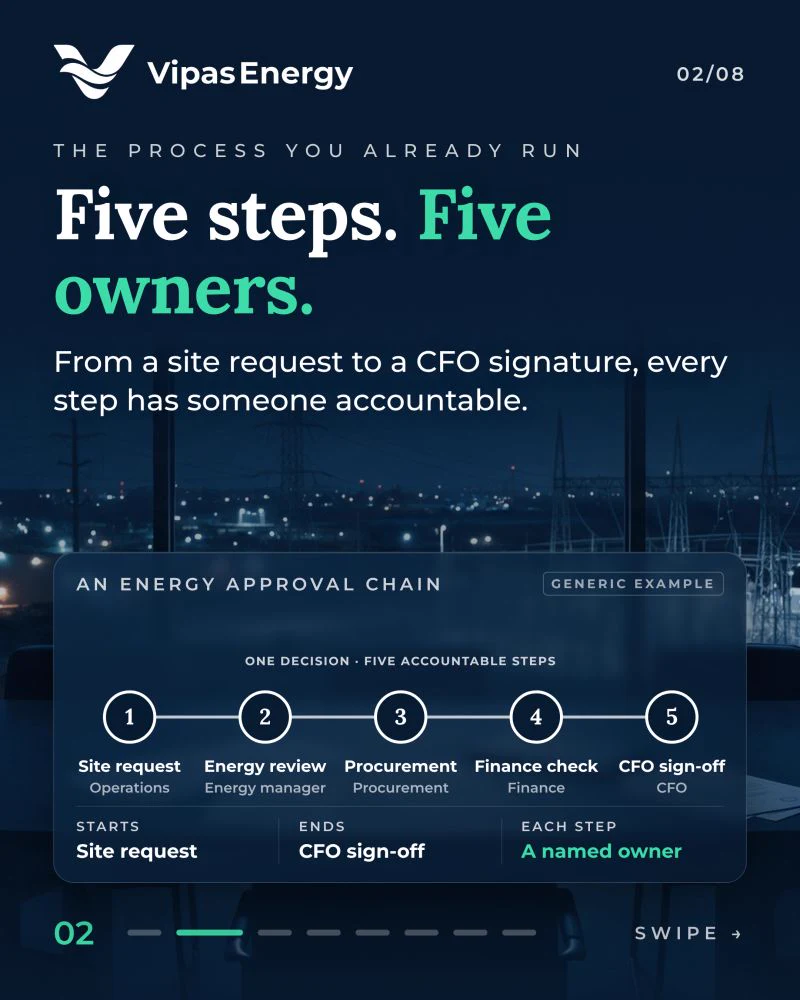
  2. The process you already run: five steps, five owners. From site request to energy review, procurement, finance check and CFO sign-off, every step has a named owner. Generic example.
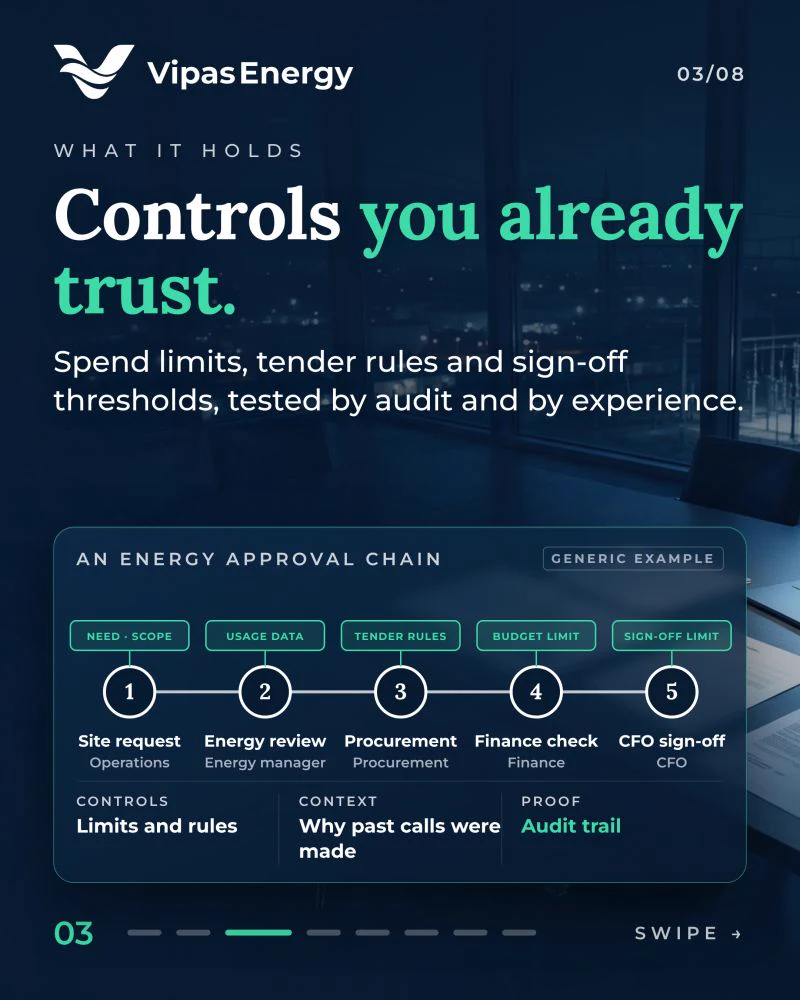
  3. What it holds: controls you already trust. Spend limits, tender rules and sign-off thresholds tested by audit and experience, plus the context of why past calls were made and an audit trail. Generic example.
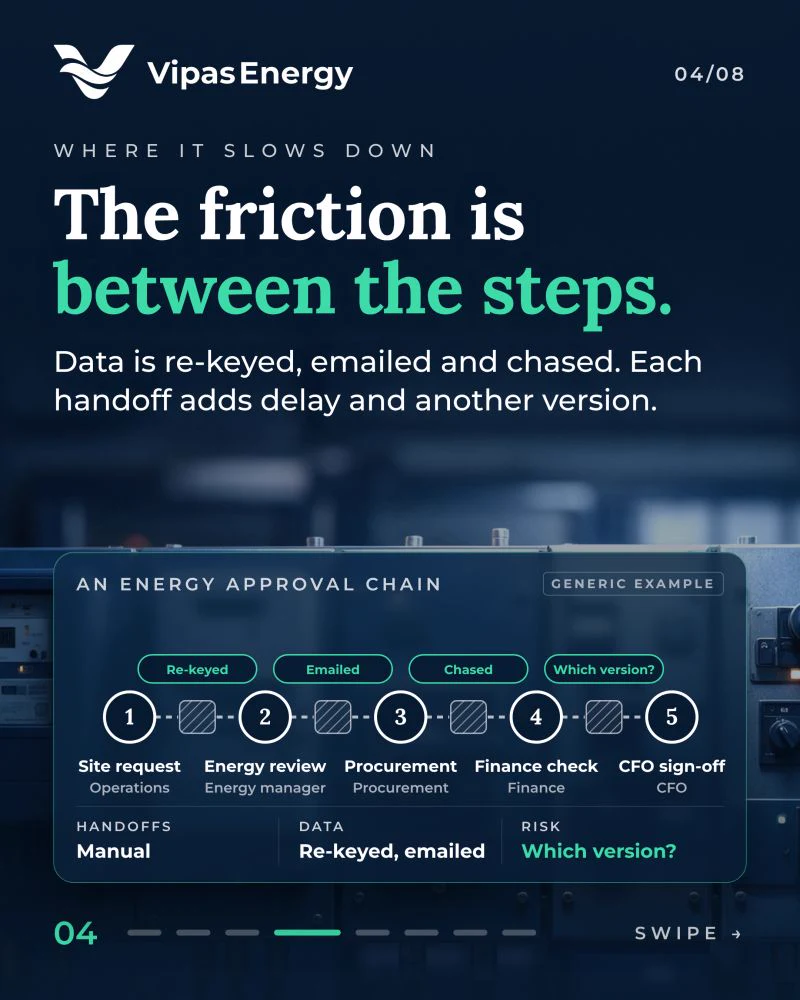
  4. Where it slows down: the friction is between the steps. Data is re-keyed, emailed and chased at each manual handoff, adding delay and another version. Generic example.
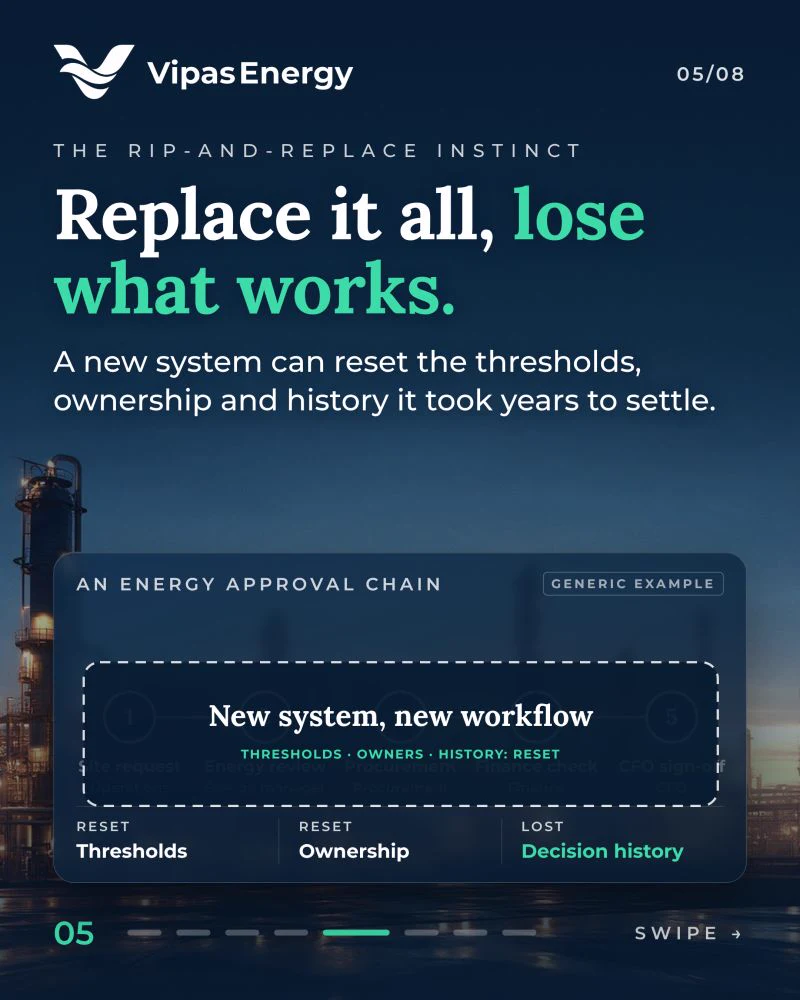
  5. The rip-and-replace instinct: replace it all, lose what works. A new system and workflow can reset thresholds and ownership and lose decision history. Generic example.
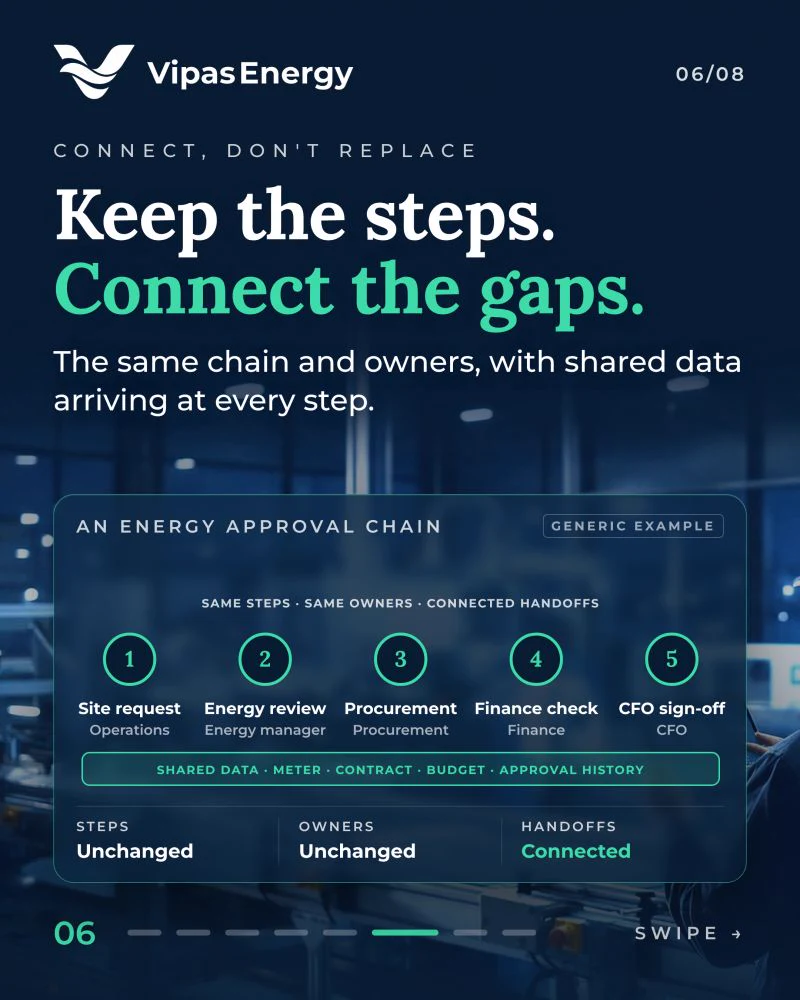
  6. Connect, don't replace: keep the steps, connect the gaps. The same chain and owners, with shared meter, contract, budget and approval-history data arriving at every step. Generic example.
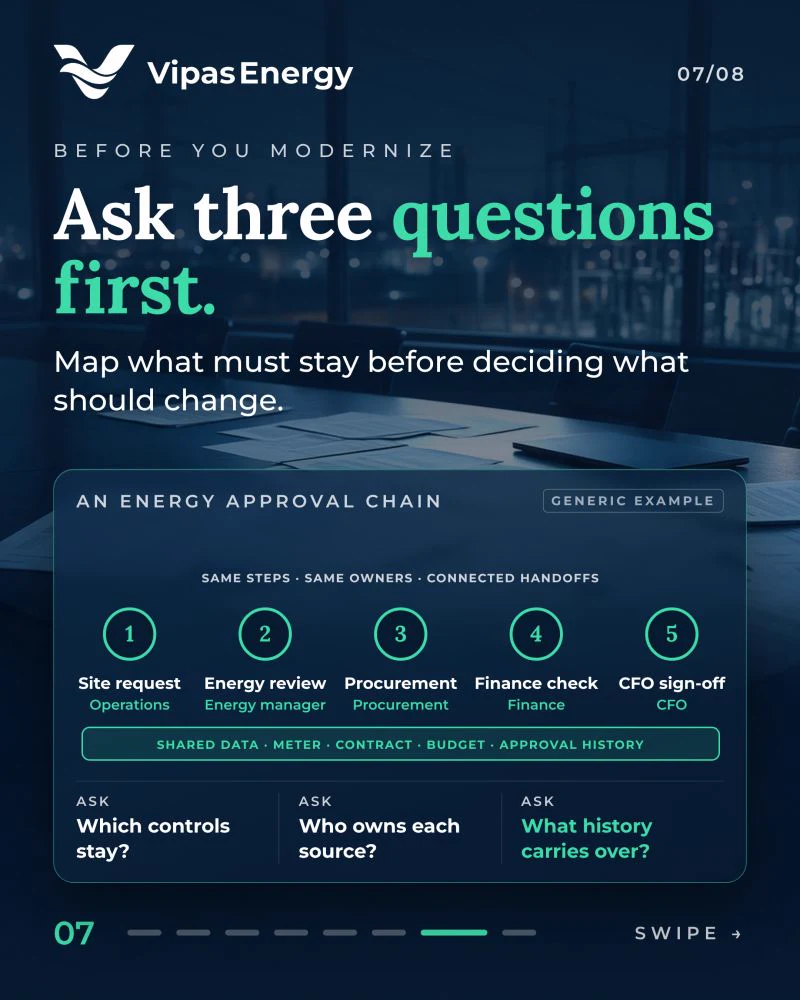
  7. Before you modernize: ask three questions first. Which controls stay? Who owns each source? What history carries over? Map what must stay before deciding what should change. Generic example.
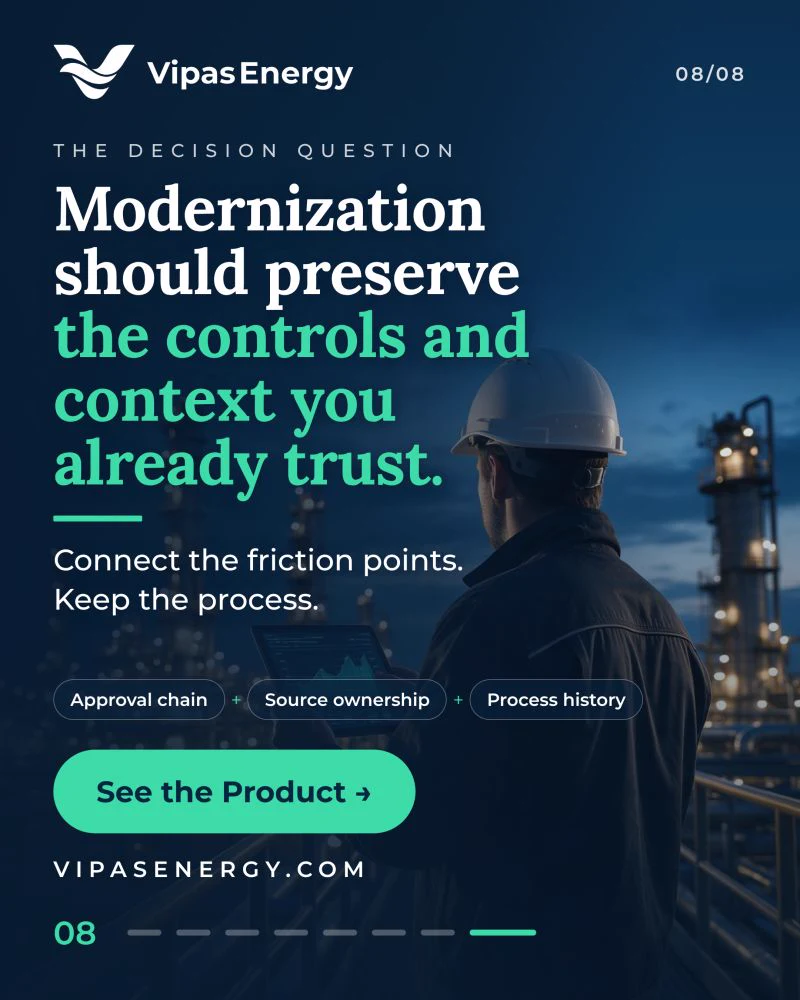
  8. Modernization should preserve the controls and context you already trust. Connect the friction points and keep the process: approval chain, source ownership and process history. See the product at vipasenergy.com.

Slide 1 of 8

Open slide 1 full size (opens in a new tab)

The post

Most organizations already run a working approval chain for energy decisions. A site raises a need. The energy manager reviews usage. Procurement runs the tender. Finance checks the budget. The CFO signs.

Each step has an owner. Each holds a control that has been tested by audit and by experience: spend limits, tender rules, sign-off thresholds, and the context behind past decisions.

The slow part is rarely the steps. It is the handoffs between them, where data is re-keyed, emailed and chased, and nobody is sure which version is current.

Replacing the whole process can reset the thresholds, ownership and history it took years to settle.

Connecting the handoffs keeps the steps and the owners, and lets shared data arrive at each one.

Before modernizing, ask three questions: Which controls must stay? Who owns each source of data? What decision history has to carry over?

Modernization should preserve the controls and context the organization already trusts.
  • #EnergyManagement
  • #DigitalTransformation
  • #CIO
  • #EnergyProcurement
  • #FinanceLeadership

About this post

Published
November 2, 2026
Format
Carousel, 8 slides
Series
Connect, Don’t Replace
Reading time
2 min
  • Open on LinkedIn (opens in a new tab)
  • Follow VIPAS Energy (opens in a new tab)
  • Slide-by-slide transcript ↓
Slide by slide

What each slide says.

A text version of the carousel. Select a thumbnail to show that slide in the viewer above.

  1. Show slide 1 in the viewer
    Slide 01

    Slide 1: Connect, don't replace: your institutional energy process is an asset, not technical debt. Before you modernize it, look at what it already does.

  2. Show slide 2 in the viewer
    Slide 02

    Slide 2: The process you already run: five steps, five owners. From site request to energy review, procurement, finance check and CFO sign-off, every step has a named owner. Generic example.

  3. Show slide 3 in the viewer
    Slide 03

    Slide 3: What it holds: controls you already trust. Spend limits, tender rules and sign-off thresholds tested by audit and experience, plus the context of why past calls were made and an audit trail. Generic example.

  4. Show slide 4 in the viewer
    Slide 04

    Slide 4: Where it slows down: the friction is between the steps. Data is re-keyed, emailed and chased at each manual handoff, adding delay and another version. Generic example.

  5. Show slide 5 in the viewer
    Slide 05

    Slide 5: The rip-and-replace instinct: replace it all, lose what works. A new system and workflow can reset thresholds and ownership and lose decision history. Generic example.

  6. Show slide 6 in the viewer
    Slide 06

    Slide 6: Connect, don't replace: keep the steps, connect the gaps. The same chain and owners, with shared meter, contract, budget and approval-history data arriving at every step. Generic example.

  7. Show slide 7 in the viewer
    Slide 07

    Slide 7: Before you modernize: ask three questions first. Which controls stay? Who owns each source? What history carries over? Map what must stay before deciding what should change. Generic example.

  8. Show slide 8 in the viewer
    Slide 08

    Slide 8: Modernization should preserve the controls and context you already trust. Connect the friction points and keep the process: approval chain, source ownership and process history. See the product at vipasenergy.com.

← Older postA cheaper tariff. Is it executable?Newer post →What has to be on the table before the CFO says yes?
More from LinkedIn

Keep reading.

All insights →
  • 8 slides

    Systems That Don’t TalkNov 20, 2026

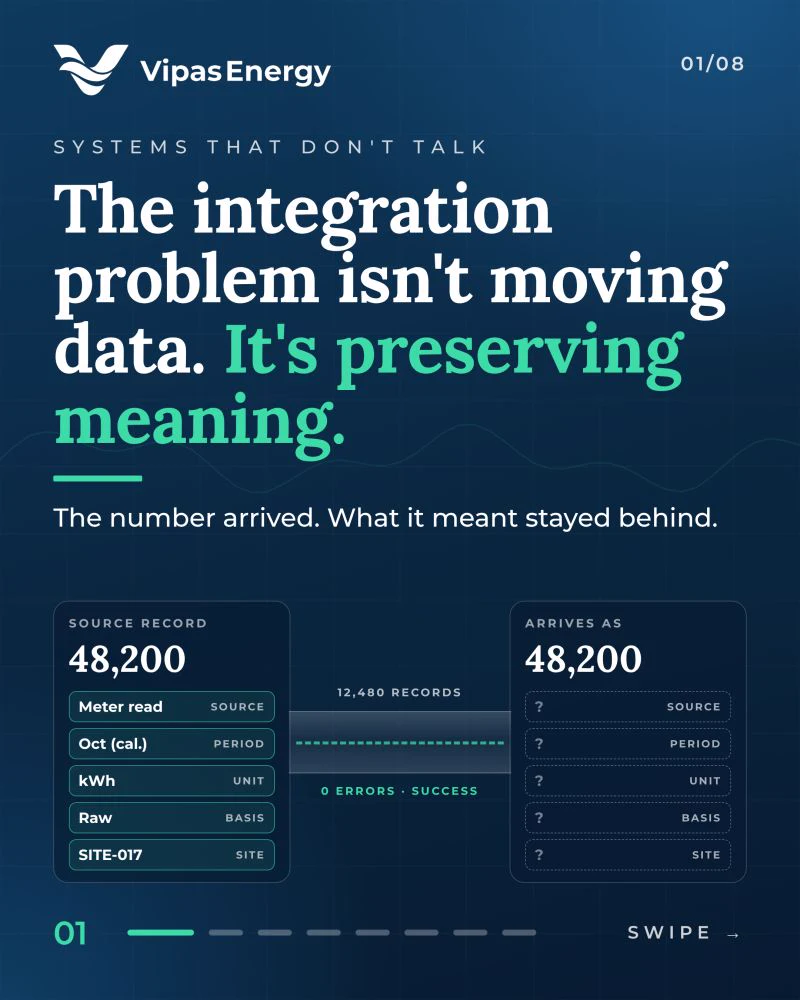
    The data moved. The meaning didn’t.

    The nightly load ran with zero errors, yet nobody can say what 48,200 means. Source, calendar, units, normalization and site identity are five labels that need to travel with every number.

    Read post →LinkedIn : The data moved. The meaning didn’t. (opens in a new tab)
  • Article

    Connect, Don’t Replace · NewsletterNov 19, 2026

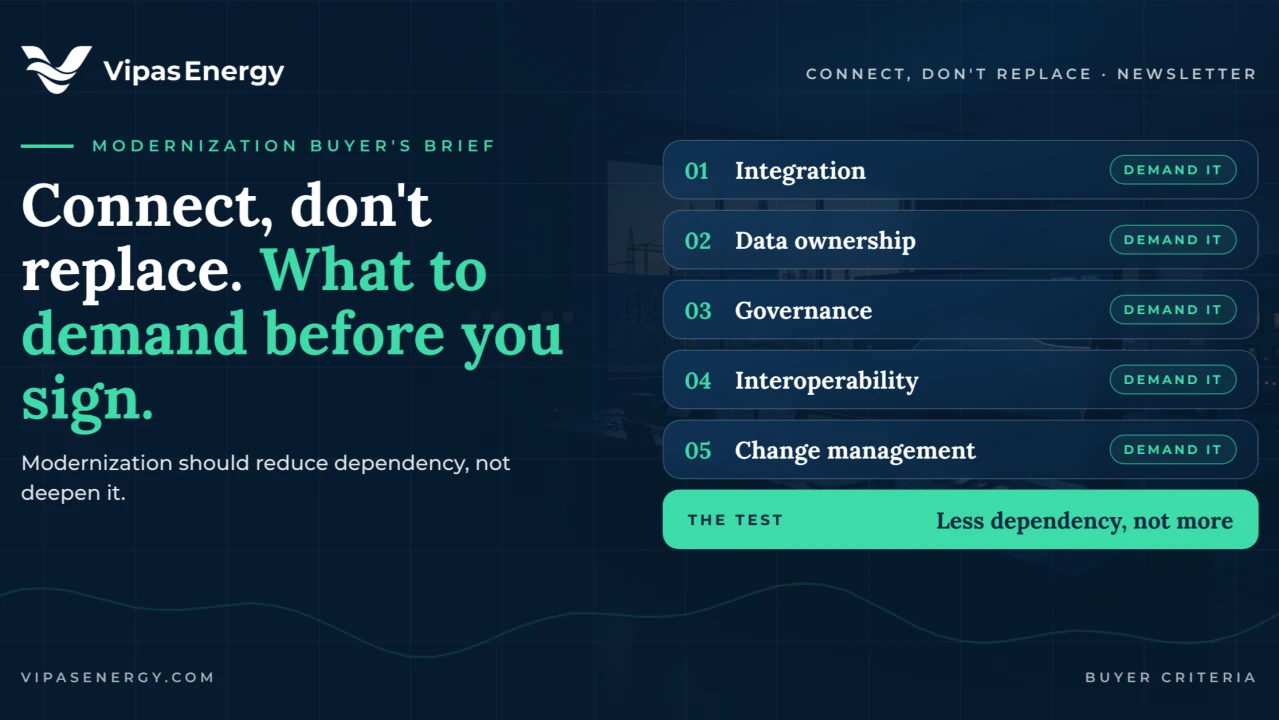
    Connect, Don’t Replace: What to Demand From an Energy Modernization Program

    Most enterprises already run the systems an energy decision needs. Before signing a modernization program, demand five things: integration, data ownership, governance, interoperability and change management.

    Read post →LinkedIn : Connect, Don’t Replace: What to Demand From an Energy Modernization Program (opens in a new tab)
  • 8 slides

    The Decision QuestionNov 18, 2026

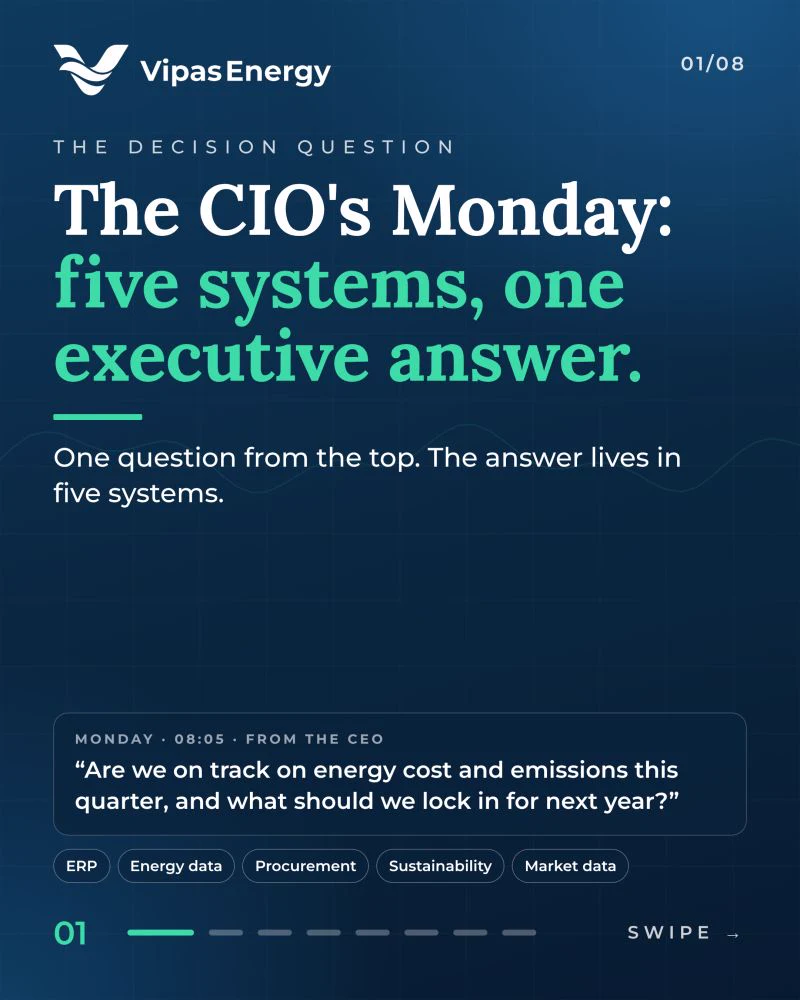
    The CIO’s Monday: five systems, one executive answer.

    One CEO question lives in five systems with five owners and five as-of dates. A new dashboard shows the disagreement faster; trusted context across systems resolves it.

    Read post →LinkedIn : The CIO’s Monday: five systems, one executive answer. (opens in a new tab)
Start with one real workflow

Where is energy fragmentation slowing your team down?

Bring a demand, sourcing, tariff, approval or reconciliation challenge. We’ll explore what a clearer operating path could look like.

Book a discovery conversation →
VIPAS Energy

Building a connected operating layer for modern energy management.

Explore

PlatformCapabilitiesOperating model

Company

About VIPASMedia & InsightsTrust & governanceContact

Use cases

Multi-site demandRates & tariffsApprovalsLinkedIn
© 2026 VIPAS Energy.Connected decisions. Clearer outcomes.