
VIPAS Energy
HomePlatformCapabilitiesOperating modelUse casesAbout
Media & InsightsBook a discovery call
  1. Home
  2. Media & Insights
  3. The CFO’s Monday: Why Did Energy Spend Miss…
The CFO’s Monday

The CFO’s Monday: Why Did Energy Spend Miss Budget When Consumption Fell?

Consumption fell, but energy spend still missed budget. Usage, rates, demand charges, contract terms and budget assumptions all shape the full cost picture.

  • October 5, 2026
  • Carousel
  • 7 slides
  • 1 min read
View on LinkedIn (opens in a new tab)Share on LinkedIn (opens in a new tab)

Carousel slides: The CFO’s Monday: Why Did Energy Spend Miss Budget When Consumption Fell?

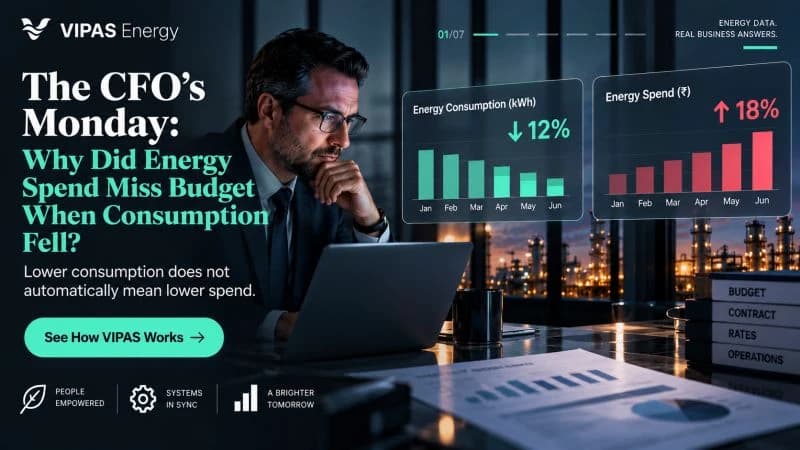
  1. The CFO’s Monday: Why Did Energy Spend Miss Budget When Consumption Fell? Lower consumption does not automatically mean lower spend.
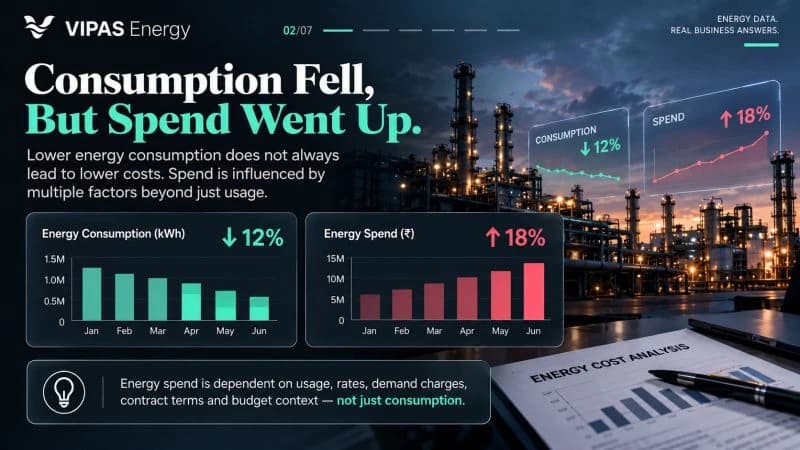
  2. Consumption Fell, But Spend Went Up. Lower energy consumption does not always lead to lower costs. The creative illustrates consumption down 12% and spend up 18%.
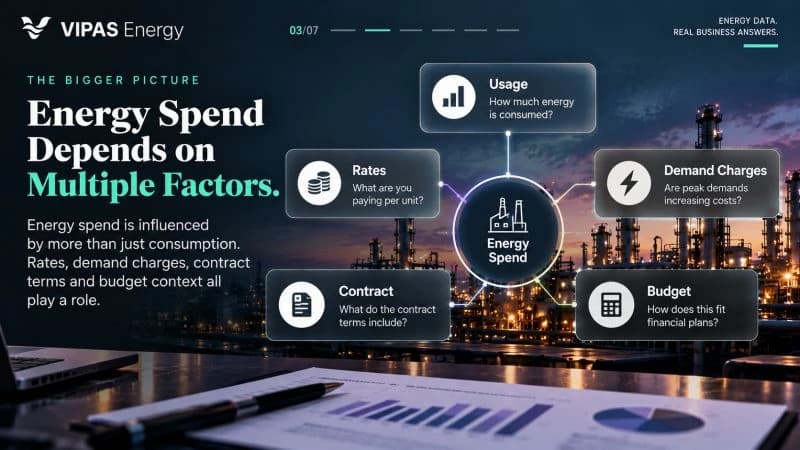
  3. Energy Spend Depends on Multiple Factors: usage, rate, demand charge, contract and budget.
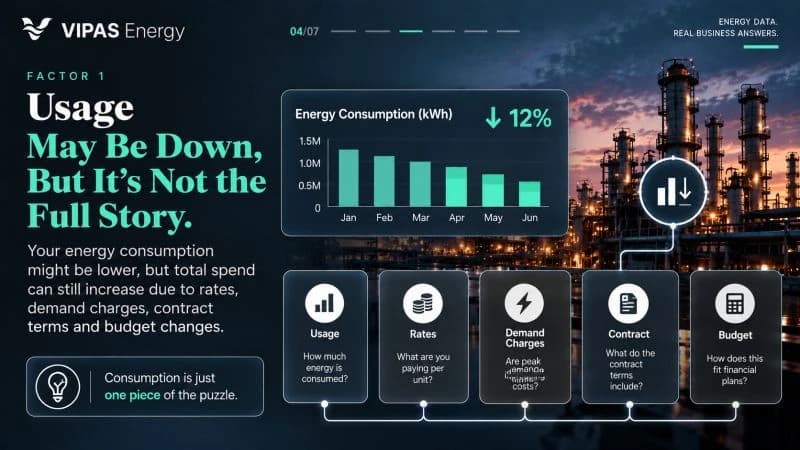
  4. Usage May Be Down, But It’s Not the Full Story. Rates, demand charges, contract terms and budget changes can still increase costs.
  5. Smarter Energy Decisions Start with a Clearer View. Understand consumption, costs and the real factors behind spend.
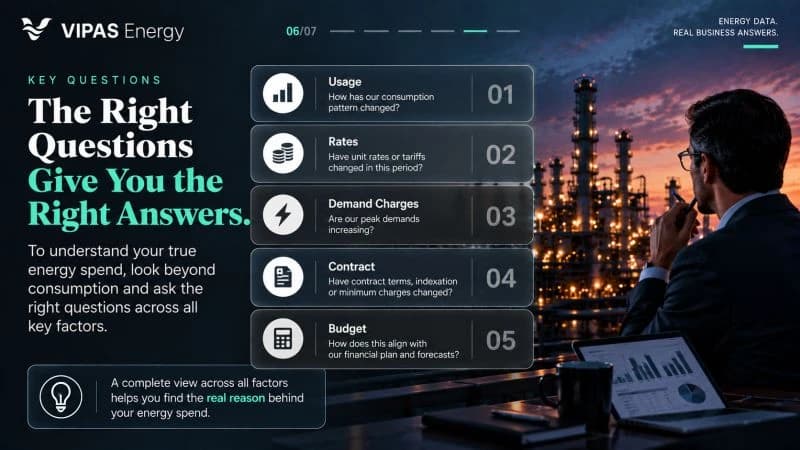
  6. The Right Questions Give You the Right Answers. Ask across usage, rates, demand charges, contract terms and budget.
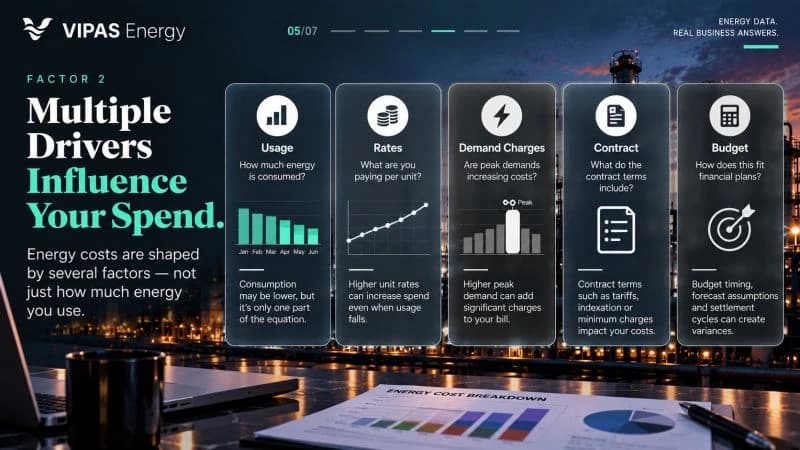
  7. Multiple Drivers Influence Your Spend. Energy costs are shaped by several factors, not just consumption.

Slide 1 of 7

Open slide 1 full size (opens in a new tab)

The post

Consumption fell. Energy spend still missed budget.

That is the kind of result that creates a second question.

Usage is only one part of the picture.

Rate can change. Demand charges can matter. Contract terms can shape the commercial outcome. And the budget itself is based on assumptions that may no longer match what the business is doing.

The question is not simply, “Did we use less energy?”

It is: “What changed across the full energy cost picture?”

Usage + Rate + Demand Charge + Contract + Budget.

  • #VIPAS
  • #EnergyManagement
  • #EnergyData
  • #EnergyProcurement
  • #Procurement
  • #CFO
  • #EnergyOperations
  • #EnergyStrategy
  • #DecisionIntelligence
  • #EnterpriseEnergy
  • #EnergyFinance
  • #EnergySpend

About this post

Published
October 5, 2026
Format
Carousel, 7 slides
Series
The CFO’s Monday
Reading time
1 min
  • Open on LinkedIn (opens in a new tab)
  • Follow VIPAS Energy (opens in a new tab)
  • Slide-by-slide transcript ↓
Slide by slide

What each slide says.

A text version of the carousel. Select a thumbnail to show that slide in the viewer above.

  1. Show slide 1 in the viewer
    Slide 01

    Slide 1: The CFO’s Monday: Why Did Energy Spend Miss Budget When Consumption Fell? Lower consumption does not automatically mean lower spend.

  2. Show slide 2 in the viewer
    Slide 02

    Slide 2: Consumption Fell, But Spend Went Up. Lower energy consumption does not always lead to lower costs. The creative illustrates consumption down 12% and spend up 18%.

  3. Show slide 3 in the viewer
    Slide 03

    Slide 3: Energy Spend Depends on Multiple Factors: usage, rate, demand charge, contract and budget.

  4. Show slide 4 in the viewer
    Slide 04

    Slide 4: Usage May Be Down, But It’s Not the Full Story. Rates, demand charges, contract terms and budget changes can still increase costs.

  5. Show slide 5 in the viewer
    Slide 05

    Slide 5: Smarter Energy Decisions Start with a Clearer View. Understand consumption, costs and the real factors behind spend.

  6. Show slide 6 in the viewer
    Slide 06

    Slide 6: The Right Questions Give You the Right Answers. Ask across usage, rates, demand charges, contract terms and budget.

  7. Show slide 7 in the viewer
    Slide 07

    Slide 7: Multiple Drivers Influence Your Spend. Energy costs are shaped by several factors, not just consumption.

← Older postAn energy decision rarely belongs to one department.Newer post →A company can report lower absolute emissions while operating efficiency has not actually improved.
More from LinkedIn

Keep reading.

All insights →
  • 7 slides

    Two Contexts. One Clear Story.Oct 7, 2026

    Two systems can show different answers without either one being “wrong.”

    Sustainability and finance can interpret the same production and energy data differently. Compare baselines, reporting periods and operating context before deciding which answer to act on.

    Read post →LinkedIn : Two systems can show different answers without either one being “wrong.” (opens in a new tab)
  • Video · 0:30

    Energy Performance in ContextOct 6, 2026

    A company can report lower absolute emissions while operating efficiency has not actually improved.

    Lower absolute emissions do not necessarily mean improved efficiency. Energy use, production output, emissions factors and the baseline together reveal the operating story.

    Read post →LinkedIn : A company can report lower absolute emissions while operating efficiency has not actually improved. (opens in a new tab)
  • Video · 0:53

    Connected Energy DecisionsSep 30, 2026

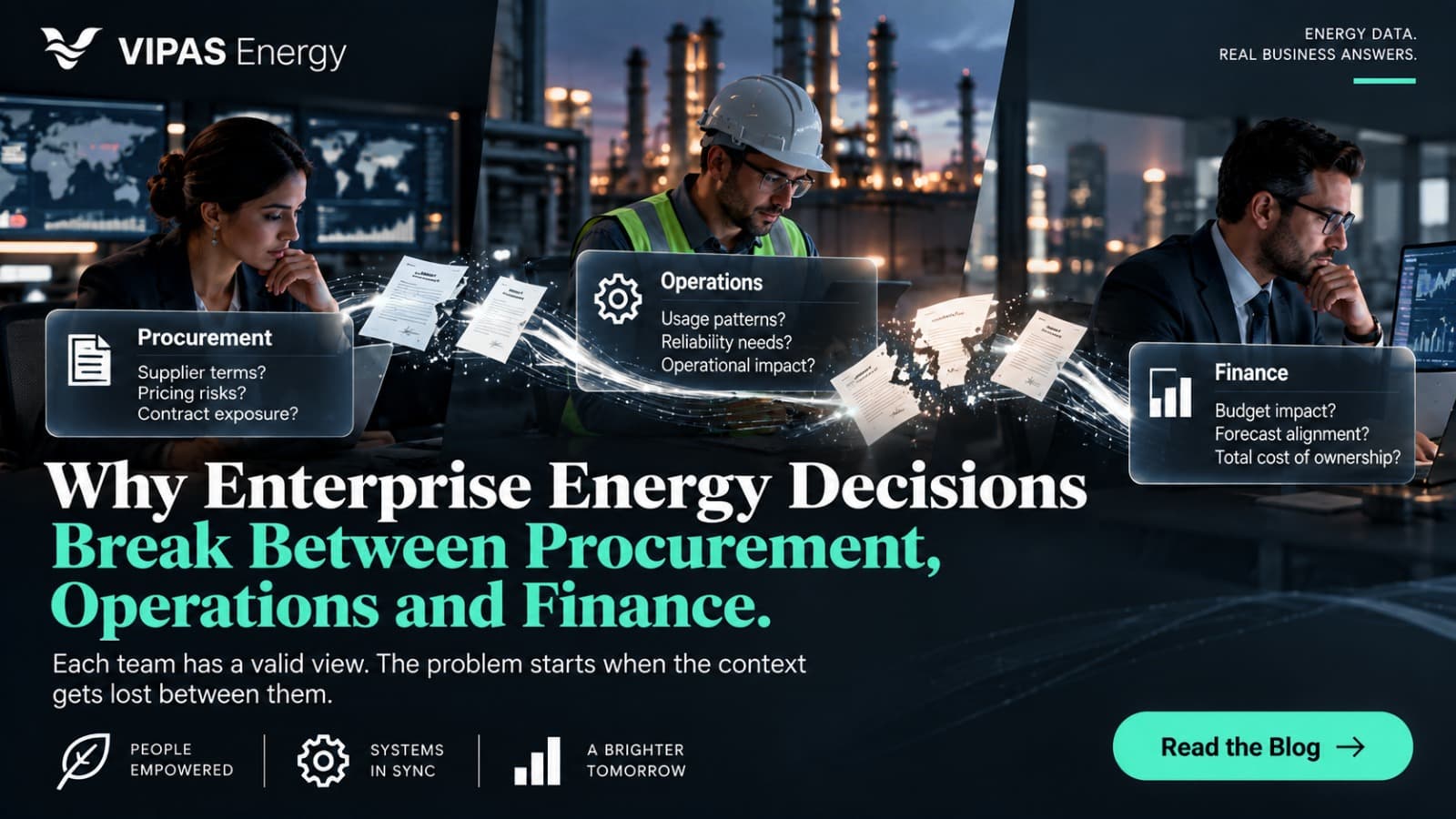
    An energy decision rarely belongs to one department.

    Procurement, operations and finance each hold a valid perspective. Better energy decisions preserve the relevant commercial context as work moves across functions.

    Read post →LinkedIn : An energy decision rarely belongs to one department. (opens in a new tab)
Start with one real workflow

Where is energy fragmentation slowing your team down?

Bring a demand, sourcing, tariff, approval or reconciliation challenge. We’ll explore what a clearer operating path could look like.

Book a discovery conversation →
VIPAS Energy

Building a connected operating layer for modern energy management.

Explore

PlatformCapabilitiesOperating model

Company

About VIPASMedia & InsightsTrust & governanceContact

Use cases

Multi-site demandRates & tariffsApprovalsLinkedIn
© 2026 VIPAS Energy.Connected decisions. Clearer outcomes.