VIPAS Energy
HomePlatformCapabilitiesOperating modelUse casesAbout
Media & InsightsBook a discovery call
  1. Home
  2. Media & Insights
  3. What changed between the approved plan and…
Ask the Business Question

What changed between the approved plan and today’s forecast?

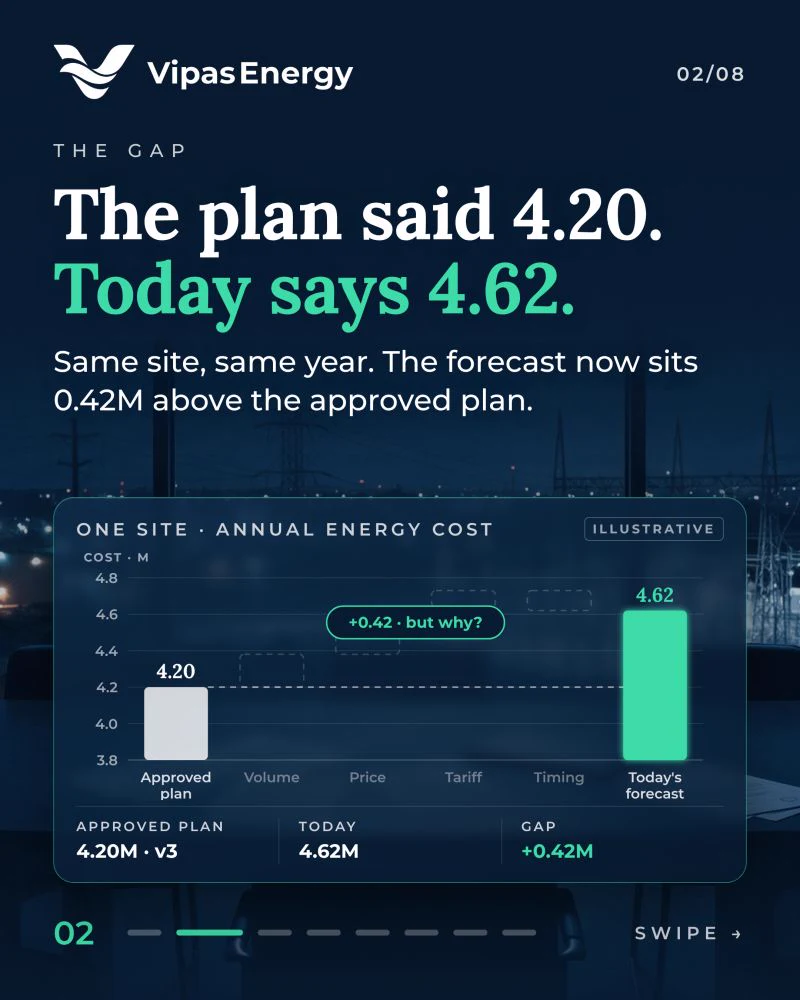
The plan said 4.20M and today’s forecast says 4.62M. The board needs the bridge: volume, price, tariff and timing, each with a driver, a source and an effect that add up to the gap.

  • November 5, 2026
  • Carousel
  • 8 slides
  • 2 min read
View on LinkedIn (opens in a new tab)Share on LinkedIn (opens in a new tab)

Carousel slides: What changed between the approved plan and today’s forecast?

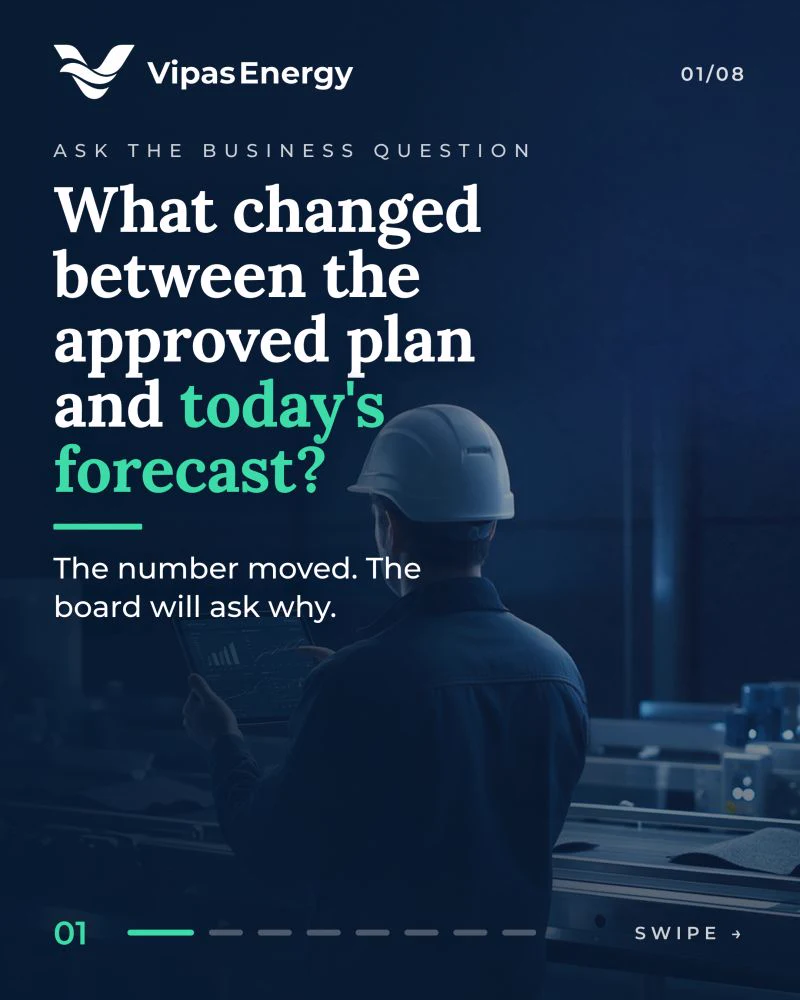
  1. Ask the Business Question: what changed between the approved plan and today's forecast? The number moved, and the board will ask why.
  2. The gap: the plan said 4.20, today says 4.62. For the same site and year, annual energy cost is now 0.42M above the approved plan version 3. Illustrative.
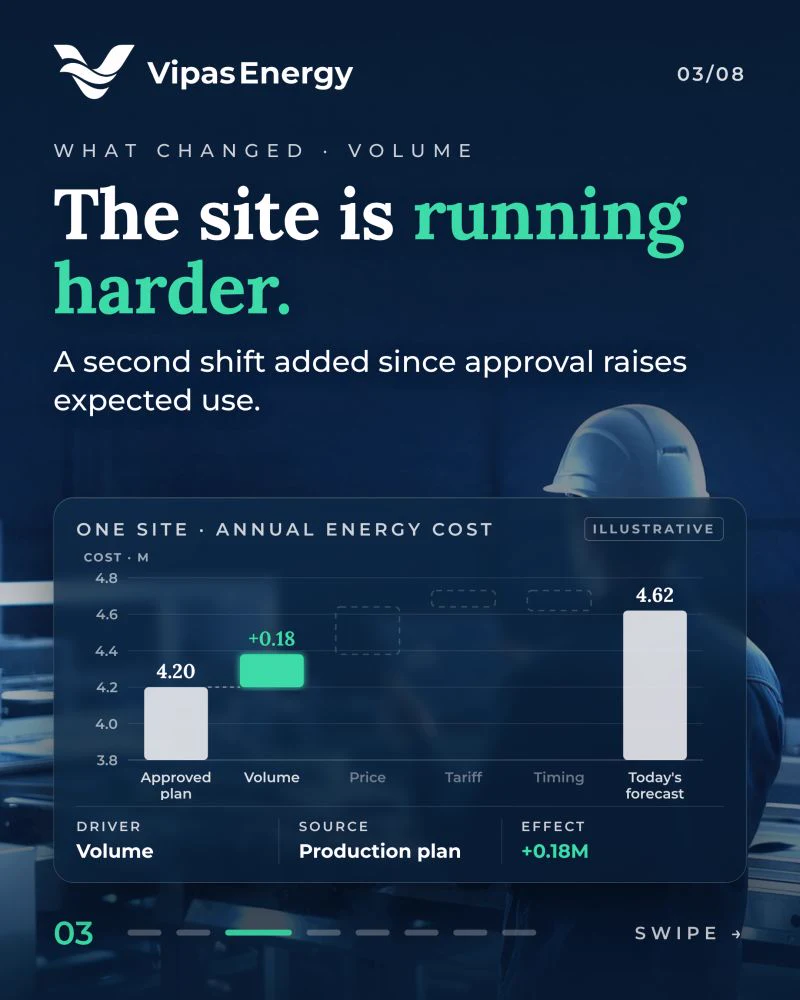
  3. What changed, volume: the site is running harder. A second shift added since approval raises expected use, adding 0.18M; source: production plan. Illustrative.
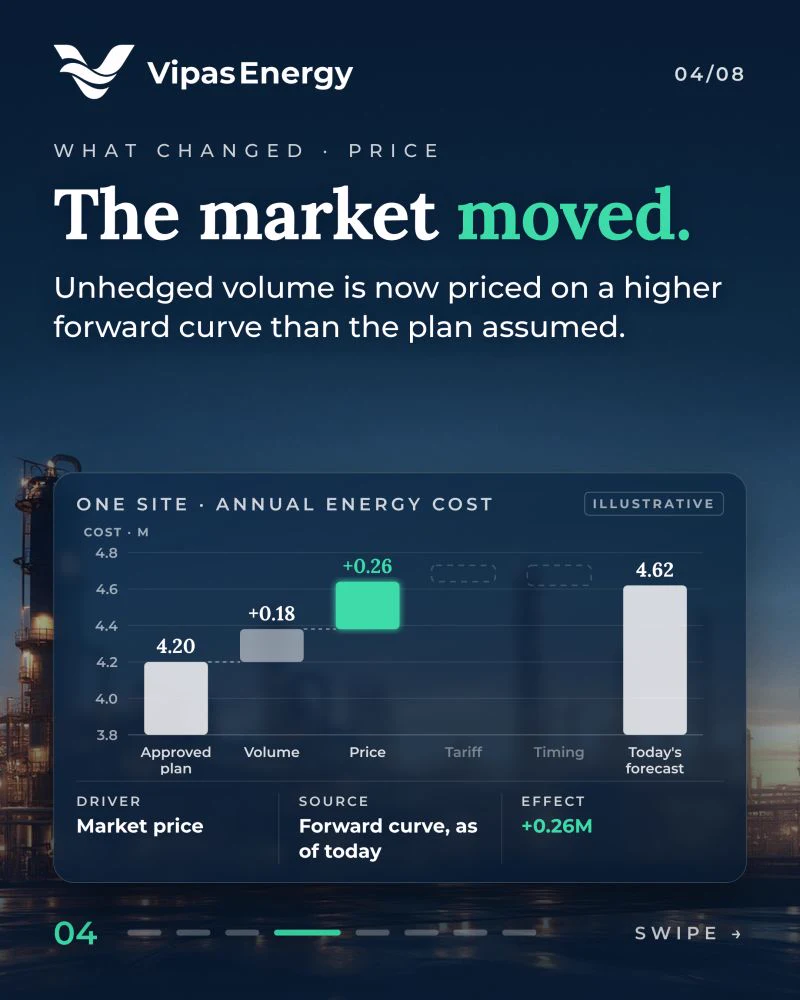
  4. What changed, price: the market moved. Unhedged volume is now priced on a higher forward curve than the plan assumed, adding 0.26M; source: forward curve as of today. Illustrative.
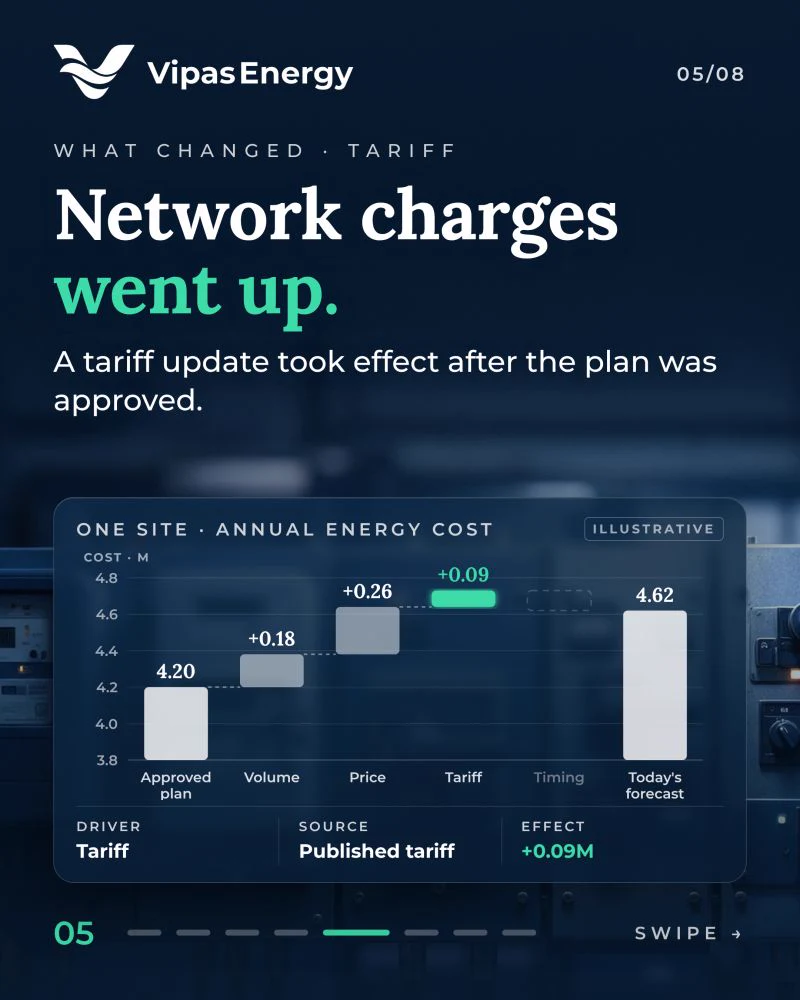
  5. What changed, tariff: network charges went up. A tariff update took effect after the plan was approved, adding 0.09M; source: published tariff. Illustrative.
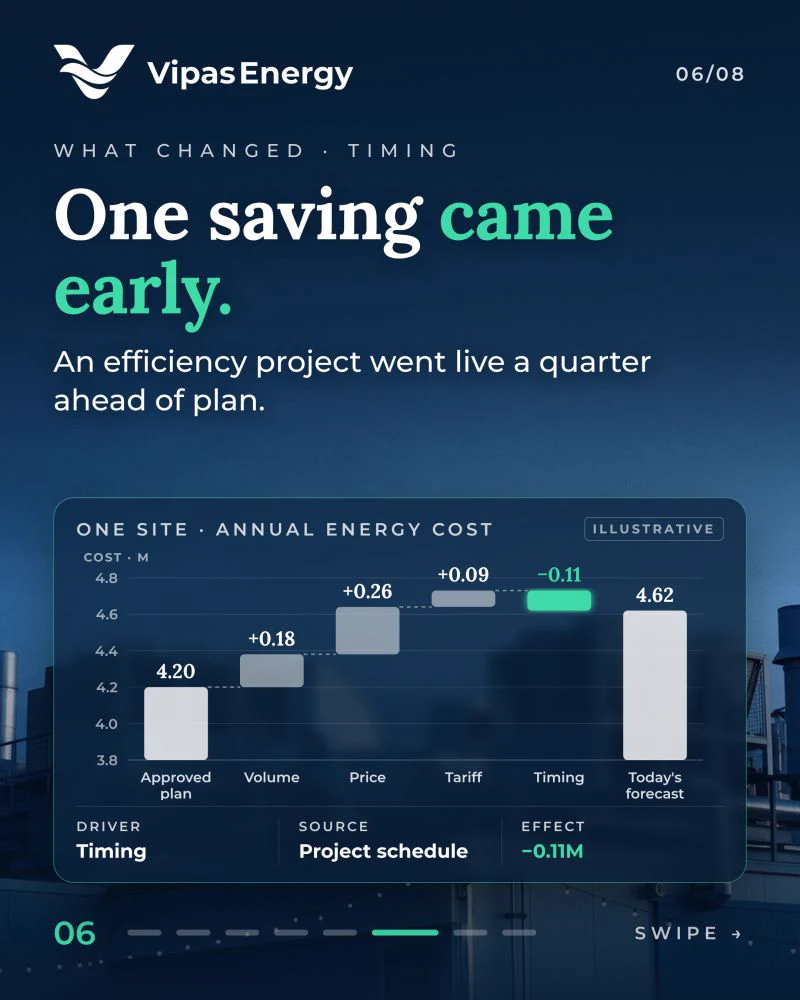
  6. What changed, timing: one saving came early. An efficiency project went live a quarter ahead of plan, reducing cost by 0.11M; source: project schedule. Illustrative.
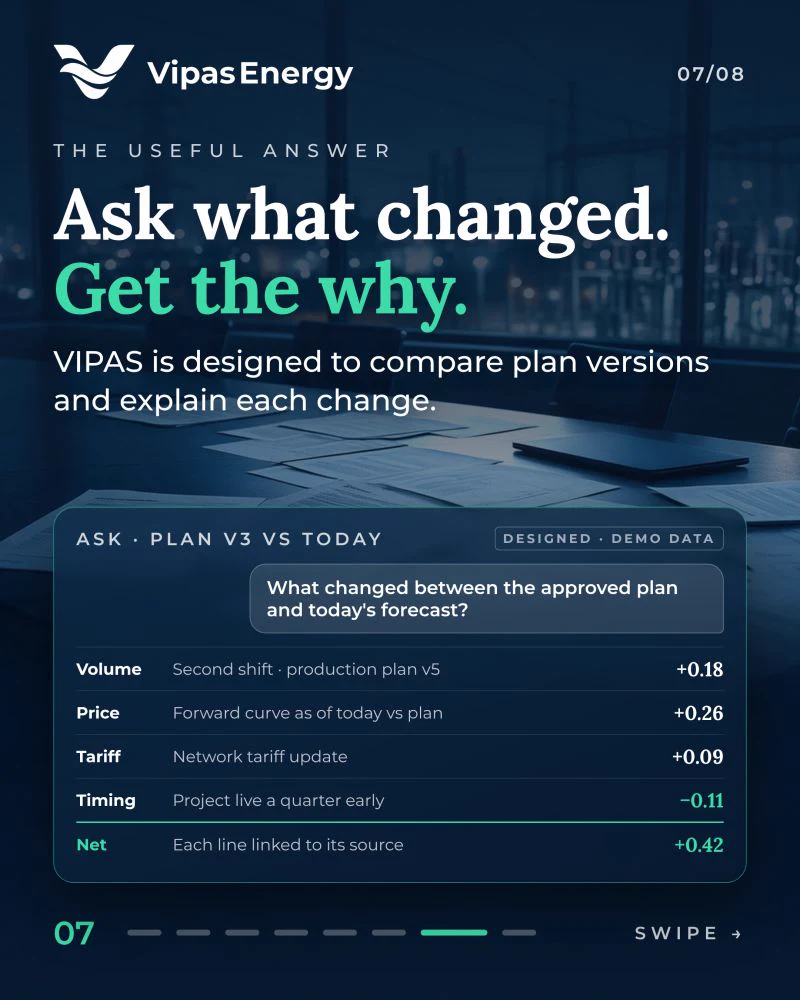
  7. The useful answer: ask what changed, get the why. VIPAS is designed to compare plan versions and explain each change: volume +0.18, price +0.26, tariff +0.09, timing −0.11, net +0.42, each line linked to its source. Designed experience, demo data.
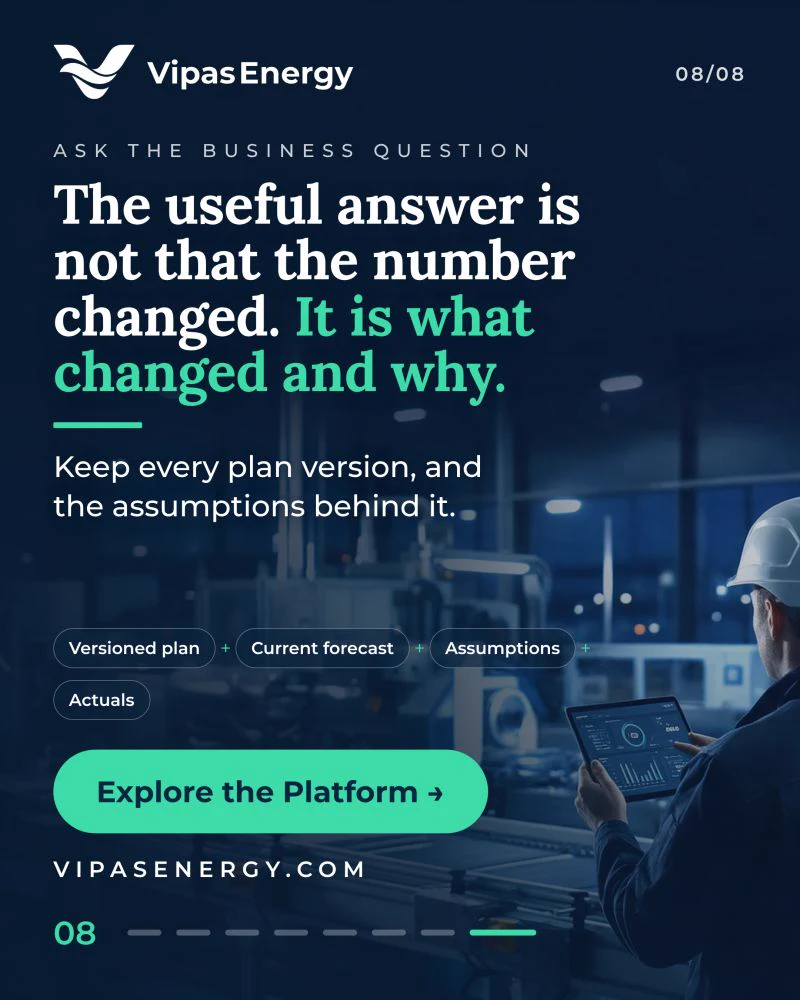
  8. The useful answer is not that the number changed; it is what changed and why. Keep every plan version and the assumptions behind it: versioned plan, current forecast, assumptions and actuals. Explore the platform at vipasenergy.com.

Slide 1 of 8

Open slide 1 full size (opens in a new tab)

The post

The plan said 4.20M. Today’s forecast says 4.62M. The board will ask why.

“The number changed” is not an answer. A CFO needs the bridge from the approved plan to today, one driver at a time.

In this illustrative example, the gap of +0.42M breaks down into four changes:

Volume: a second shift added since approval, +0.18M Price: unhedged volume on a higher forward curve, +0.26M Tariff: a network charge update after approval, +0.09M Timing: an efficiency project live a quarter early, −0.11M

Each line has a driver, a source and an effect, and together they add up to the gap.

That is only possible when the approved plan version, the current forecast, the assumptions behind both and the actuals sit in one place.

VIPAS is designed to let finance ask that question directly and get the explanation back, line by line.

The useful answer is not that the number changed. It is what changed and why.

NoteIllustrative example. The designed experience is shown with demo data.
  • #EnergyManagement
  • #CFO
  • #FinancialPlanning
  • #EnergyProcurement
  • #Forecasting

About this post

Published
November 5, 2026
Format
Carousel, 8 slides
Series
Ask the Business Question
Reading time
2 min
  • Open on LinkedIn (opens in a new tab)
  • Follow VIPAS Energy (opens in a new tab)
  • Slide-by-slide transcript ↓
Slide by slide

What each slide says.

A text version of the carousel. Select a thumbnail to show that slide in the viewer above.

  1. Show slide 1 in the viewer
    Slide 01

    Slide 1: Ask the Business Question: what changed between the approved plan and today's forecast? The number moved, and the board will ask why.

  2. Show slide 2 in the viewer
    Slide 02

    Slide 2: The gap: the plan said 4.20, today says 4.62. For the same site and year, annual energy cost is now 0.42M above the approved plan version 3. Illustrative.

  3. Show slide 3 in the viewer
    Slide 03

    Slide 3: What changed, volume: the site is running harder. A second shift added since approval raises expected use, adding 0.18M; source: production plan. Illustrative.

  4. Show slide 4 in the viewer
    Slide 04

    Slide 4: What changed, price: the market moved. Unhedged volume is now priced on a higher forward curve than the plan assumed, adding 0.26M; source: forward curve as of today. Illustrative.

  5. Show slide 5 in the viewer
    Slide 05

    Slide 5: What changed, tariff: network charges went up. A tariff update took effect after the plan was approved, adding 0.09M; source: published tariff. Illustrative.

  6. Show slide 6 in the viewer
    Slide 06

    Slide 6: What changed, timing: one saving came early. An efficiency project went live a quarter ahead of plan, reducing cost by 0.11M; source: project schedule. Illustrative.

  7. Show slide 7 in the viewer
    Slide 07

    Slide 7: The useful answer: ask what changed, get the why. VIPAS is designed to compare plan versions and explain each change: volume +0.18, price +0.26, tariff +0.09, timing −0.11, net +0.42, each line linked to its source. Designed experience, demo data.

  8. Show slide 8 in the viewer
    Slide 08

    Slide 8: The useful answer is not that the number changed; it is what changed and why. Keep every plan version and the assumptions behind it: versioned plan, current forecast, assumptions and actuals. Explore the platform at vipasenergy.com.

← Older postWhat has to be on the table before the CFO says yes?Newer post →The rule flags it. People explain it.
More from LinkedIn

Keep reading.

All insights →
  • 8 slides

    Systems That Don’t TalkNov 20, 2026

    The data moved. The meaning didn’t.

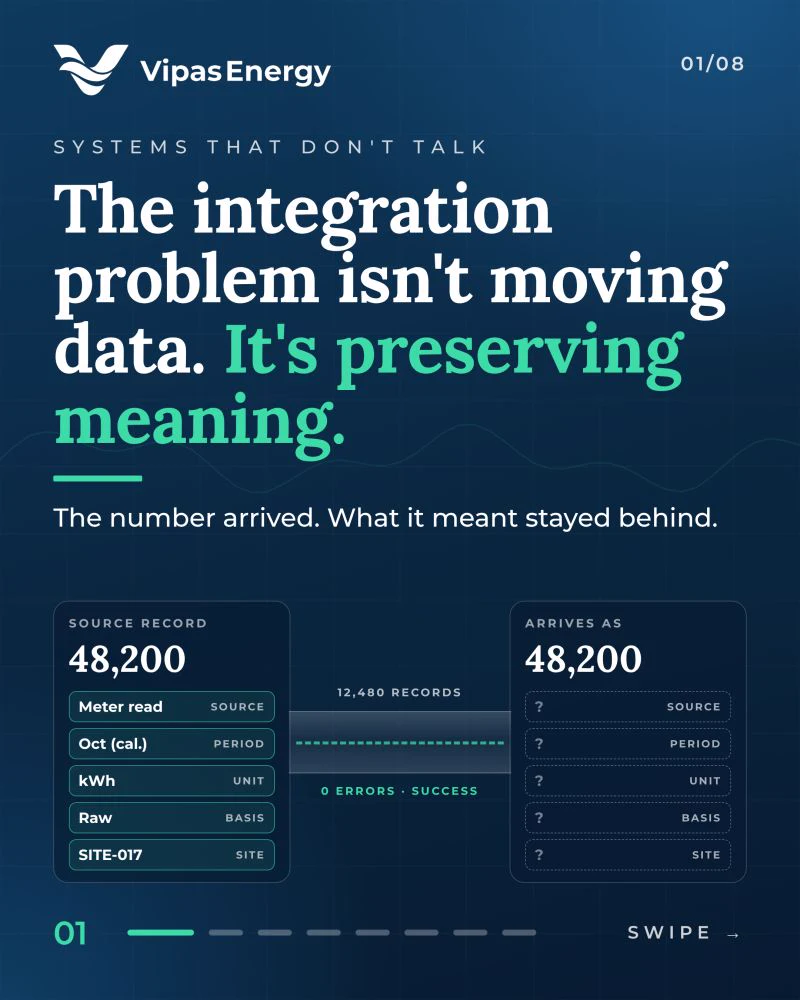
    The nightly load ran with zero errors, yet nobody can say what 48,200 means. Source, calendar, units, normalization and site identity are five labels that need to travel with every number.

    Read post →LinkedIn : The data moved. The meaning didn’t. (opens in a new tab)
  • Article

    Connect, Don’t Replace · NewsletterNov 19, 2026

    Connect, Don’t Replace: What to Demand From an Energy Modernization Program

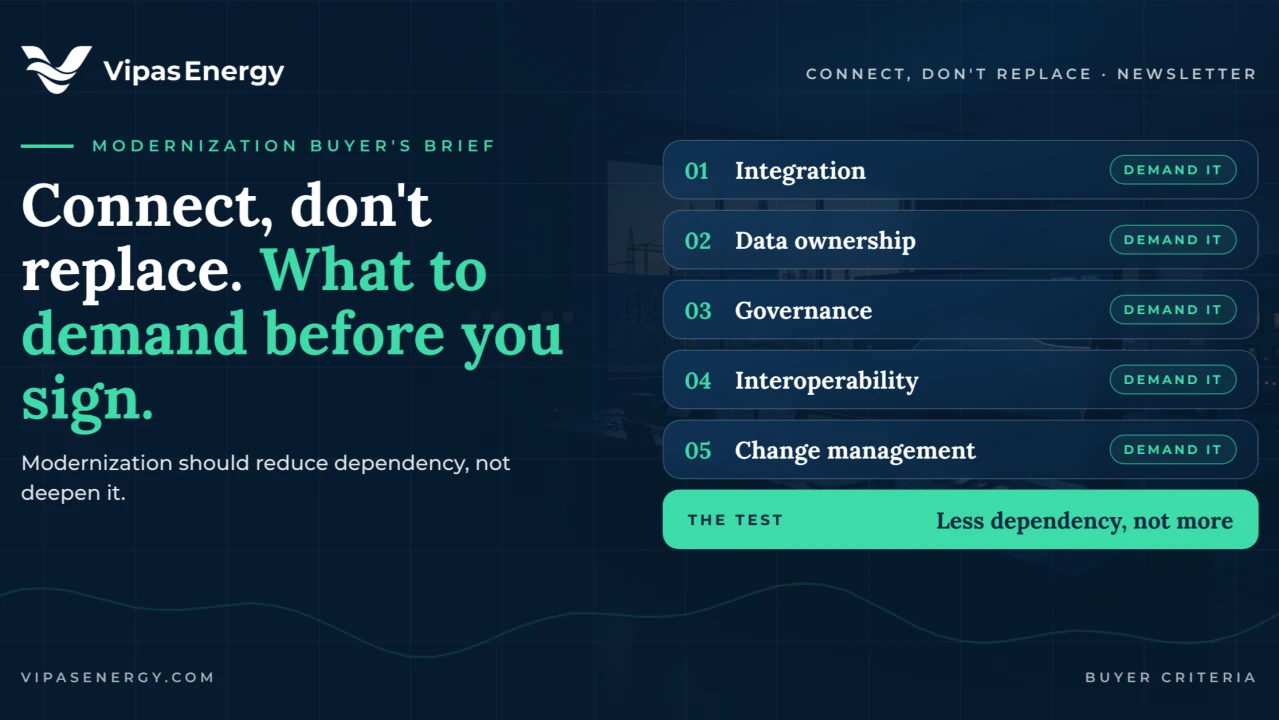
    Most enterprises already run the systems an energy decision needs. Before signing a modernization program, demand five things: integration, data ownership, governance, interoperability and change management.

    Read post →LinkedIn : Connect, Don’t Replace: What to Demand From an Energy Modernization Program (opens in a new tab)
  • 8 slides

    The Decision QuestionNov 18, 2026

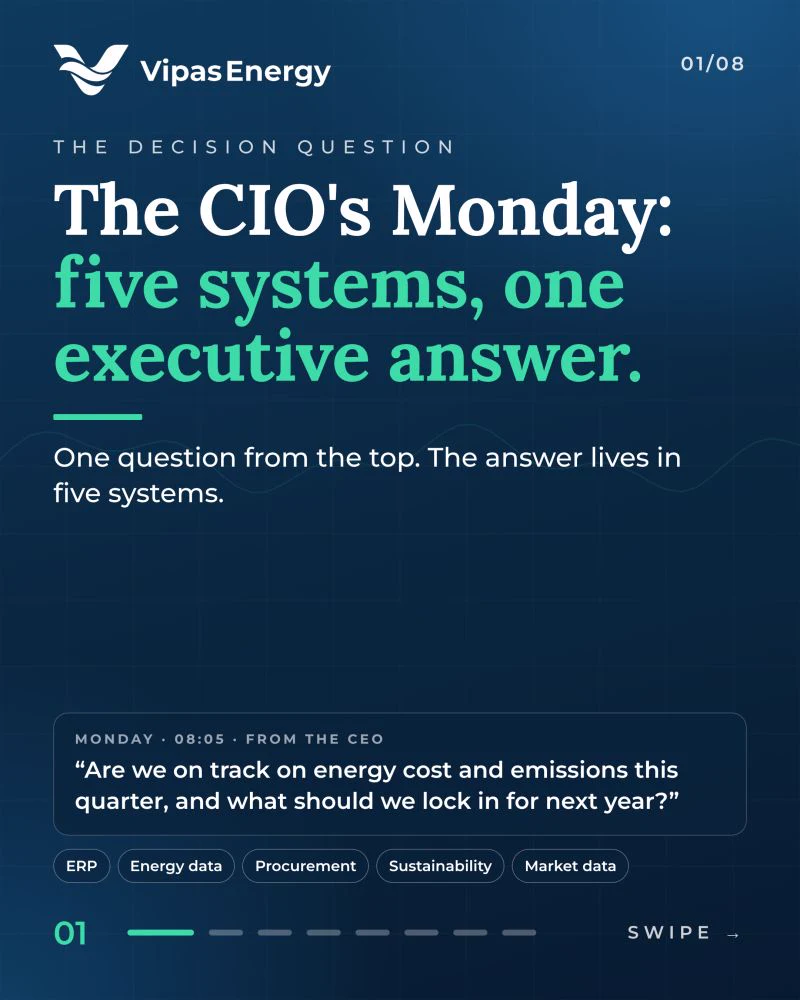
    The CIO’s Monday: five systems, one executive answer.

    One CEO question lives in five systems with five owners and five as-of dates. A new dashboard shows the disagreement faster; trusted context across systems resolves it.

    Read post →LinkedIn : The CIO’s Monday: five systems, one executive answer. (opens in a new tab)
Start with one real workflow

Where is energy fragmentation slowing your team down?

Bring a demand, sourcing, tariff, approval or reconciliation challenge. We’ll explore what a clearer operating path could look like.

Book a discovery conversation →
VIPAS Energy

Building a connected operating layer for modern energy management.

Explore

PlatformCapabilitiesOperating model

Company

About VIPASMedia & InsightsTrust & governanceContact

Use cases

Multi-site demandRates & tariffsApprovalsLinkedIn
© 2026 VIPAS Energy.Connected decisions. Clearer outcomes.